Tuesday
Tuesday: The Rule for Every Corner
Raven pins the triangle to the origin of the paper grid with a paper fastener. "Quarter turn. Counterclockwise."
Rocket turns it. "B was at (4, 1). Now it is at (-1, 4). The numbers swapped and one went negative."
"Try another corner before you decide the rule," Raven says. "What do you notice?"
"C was (1, 3). Now (-3, 1). Yes, swap them, then make the first one negative." He writes (-y, x).
Nova hovers over the pinned corner, her light a small circle. "Now the flip," she says. "Across the y-axis."
Rocket flips the triangle over the axis. "(4, 1) goes to (-4, 1). Only x changes sign." Nova hums. "Rules, not guesses."
Coordinate rules
| Move | Rule | Example |
|---|---|---|
| slide a right, b up | (x + a, y + b) | slide 3 right, 2 up: (4, 1) to (7, 3) |
| flip across the x-axis | (x, -y) | (4, 1) to (4, -1) |
| flip across the y-axis | (-x, y) | (4, 1) to (-4, 1) |
| quarter turn counterclockwise about the origin | (-y, x) | (4, 1) to (-1, 4) |
| half turn about the origin | (-x, -y) | (4, 1) to (-4, -1) |
A slide adds the same numbers to every corner. A flip changes the sign of one coordinate. A turn swaps and changes signs.
Left and down are negative: a slide 2 left and 5 down is (x - 2, y - 5).
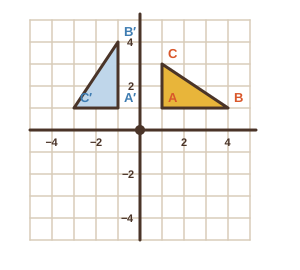
- Name the move and write its rule.
- Take one corner and put its x and y into the rule.
- Repeat for every corner. Plot the new points and join them.
- Check: lay the original on the image. Same lengths, same angles.
- Read the question.
- Tap your answer.
- Read the question.
- Tap your answer.
- Read the question.
- Tap your answer.
| Statement | True or false? |
|---|---|
| A flip across the y-axis changes the sign of x and keeps y. | ? |
| A slide changes the sign of both coordinates. | ? |
| A quarter turn counterclockwise sends (x, y) to (-y, x). | ? |
| A point on the y-axis stays put when flipped across the y-axis. | ? |
Turn the triangle a quarter turn. Read each new corner and check it against (-y, x).
Paper fasteners stay away from children under three and pets.
Rules, not guesses. Tomorrow is Build Lab: the tiles move on the floor grid, and you measure what stays the same.