Thursday
Thursday: Raven's Tile Log
Raven opens the Blueprint Book to a full page of coordinates. "Every corner of the L, before and after each move."
"Six corners, three moves, eighteen new points," Rocket says. "You wrote them all?"
"The rules wrote them," Raven says. "I checked a few on the floor. What do you notice in the flip column?"
"Every x flipped its sign. Every y stayed," Rocket says. "And in the turn column they swap."
Nova hovers over the log, her light moving down the page. "Now a harder one," she says. "Two moves in a row."
"Flip, then slide," Rocket says. "Or slide, then flip. Do they land in the same place?" Nova hums. "Find out."
Reading the log
The crew's tile log, made at the Blueprint Table. Each row is one corner of the L and where it lands after each move.
| Corner | Before | Slide (x + 3, y - 5) | Flip (-x, y) | Turn (-y, x) |
|---|---|---|---|---|
| A | (1, 1) | (4, -4) | (-1, 1) | (-1, 1) |
| B | (3, 1) | (6, -4) | (-3, 1) | (-1, 3) |
| C | (3, 2) | (6, -3) | (-3, 2) | (-2, 3) |
| D | (2, 2) | (5, -3) | (-2, 2) | (-2, 2) |
| E | (2, 4) | (5, -1) | (-2, 4) | (-4, 2) |
| F | (1, 4) | (4, -1) | (-1, 4) | (-4, 1) |
Read a row: corner B starts at (3, 1). The slide sends it to (6, -4), the flip to (-3, 1), the quarter turn to (-1, 3).
Every row follows the same three rules. That is what makes a log like this quick to write and easy to check.
Two moves in a row, and congruence
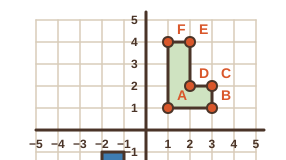
Flip the tile across the y-axis, then slide it 5 down. Corner A at (1, 1) goes to (-1, 1), then to (-1, -4).
Two figures are congruent when some sequence of slides, flips and turns lands one exactly on the other. The blue tile is congruent to the gold one.
To show two tiles are congruent, name the moves. To show two tiles are not, find a side or an angle that differs.
- Read the question.
- Tap your answer.
- Read the question.
- Tap your answer.
| Statement | True or false? |
|---|---|
| Two tiles are congruent if a sequence of slides, flips and turns lands one on the other. | ? |
| A flip then a slide always gives the same image as a slide then the same flip. | ? |
| The image of the L after a quarter turn is congruent to the L. | ? |
| Stretching a tile to twice its size is one of this week's three moves. | ? |
Start over. Slide 5 down first, then flip. Compare the two images. Are they in the same place?
Eighteen new points, three rules. Tomorrow you spot slides, flips and turns around the house and review.