Tuesday
Tuesday: Half Cubes and Fraction Edges
Rocket slides the lid onto the bin and frowns. "The top layer does not fit. The box is too short."
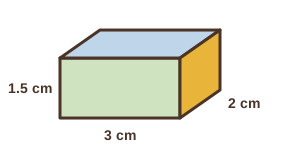
Raven measures with her ruler. "Three units long, two wide, and one and a half tall. What do you notice?"
"Half a cube at the top," Rocket says. "Nothing fits a half."
Nova hovers over the gap, her light shrinking to a small square. "What if the cubes were smaller?" she says.
Rocket grabs the box of tiny cubes. "Half-unit cubes! Two fit along every unit."
He fills the bottom layer: six long, four wide. Three layers reach the lid exactly.
"Seventy-two half cubes," Raven says. "Now, how many unit cubes is that?"
Nova hums. "Count how many little cubes make one big cube first."
A half-unit cube
A half-unit cube has every edge 1/2 unit long. Two fit along each edge of a unit cube.
So a unit cube holds 2 × 2 × 2 = 8 half-unit cubes. Each half-unit cube is 1/8 of a cubic unit.
Half cubes let us pack a box whose edges are not whole numbers. Then we turn the count back into cubic units.
The crew's bin, two ways
| Edge | Length in units | Half cubes along it |
|---|---|---|
| length | 3 | 6 |
| width | 2 | 4 |
| height | 1 1/2 | 3 |
Pack it: 6 × 4 × 3 = 72 half cubes. Each is 1/8 of a cubic unit, so 72 ÷ 8 = 9 cubic units.
Multiply the edges: 3 × 2 × 1 1/2 = 9 cubic units. The same number, so the formula still works.
This is the point of the week: V = l × w × h is true for fraction edges too. Packing proves it.
- Read the question.
- Tap your answer.
- Read the question.
- Tap your answer.
- Read the question.
- Tap your answer.
What is the volume of the box in cubic centimeters?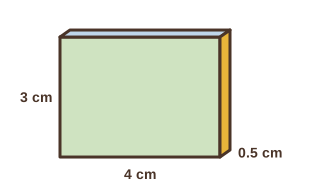 What is the volume of the box in cubic centimeters?
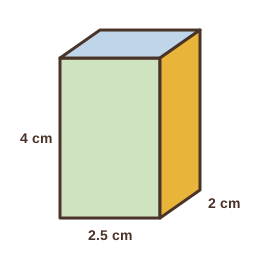 What is the volume of the box in cubic centimeters?
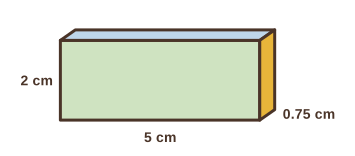 What is the volume of the box in cubic centimeters?
- ?Measure the three edges in units.
- ?Count how many half cubes fit along each edge: twice the length.
- ?Multiply the three counts to get the number of half cubes.
- ?Divide by 8 to turn half cubes into cubic units.
- ?Check: multiply the three edge lengths. The answers match.
Fraction edges, same formula. Tomorrow is Build Lab: pack three boxes and check every count.