Monday
Monday: Layers of Cubes
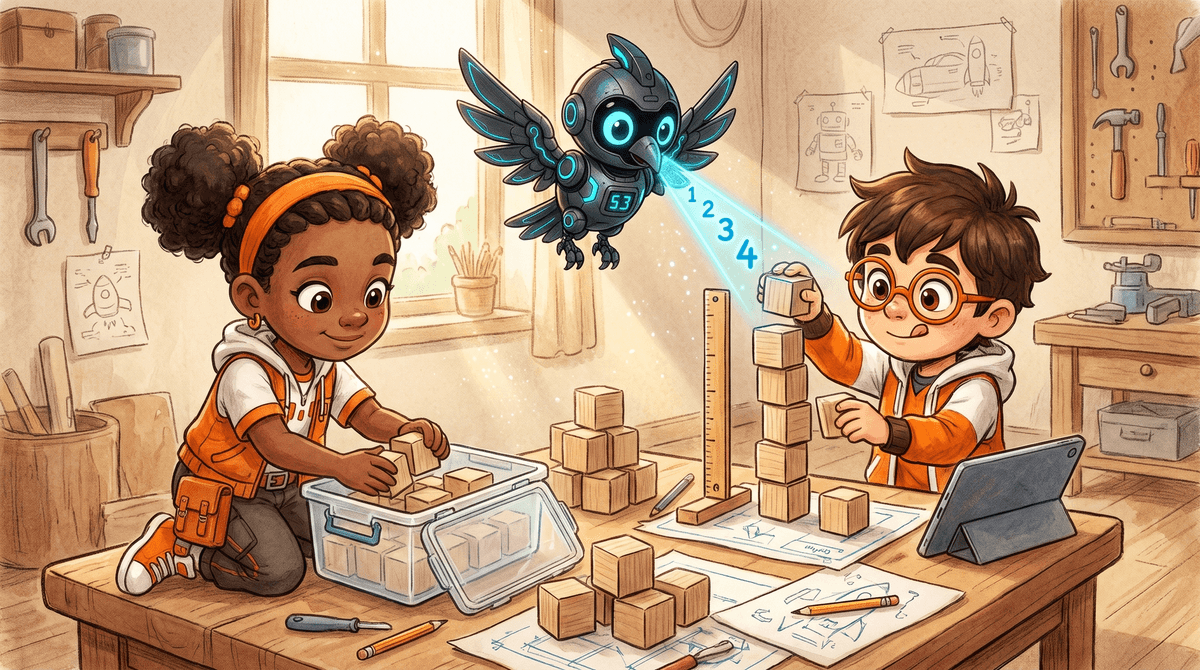
Rocket tips a bag of small cubes onto the Blueprint Table. "The storage bin! How many of these fit inside?"
He drops cubes into the clear box one at a time. "Twelve, thirteen, fourteen." A cube bounces onto the floor.
"What do you notice about the bottom layer?" Raven asks. She has already lined it up: four cubes long, three cubes wide.
"Twelve in a layer," Rocket says. "And the box is two cubes tall. Two layers."
Nova hovers over the box, her light sliding down one side. "A layer at a time," she says. "Then count the layers."
"Twelve and twelve," Rocket says. "Twenty-four cubes. That is how much it holds."
Raven writes it in the Blueprint Book: 4 × 3 × 2 = 24 cubic units.
Volume is a count of cubes
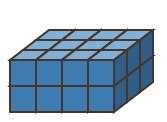
Volume is the space inside a solid. We measure it by counting unit cubes: cubes with every edge 1 unit long.
The bin's bottom layer is 4 cubes by 3 cubes, so one layer holds 4 × 3 = 12 cubes.
The bin is 2 cubes tall, so it holds 2 layers: 2 × 12 = 24 cubes. Its volume is 24 cubic units.
Two formulas, one idea
Length times width times height: V = l × w × h. For the bin, 4 × 3 × 2 = 24.
Base area times height: V = B × h. The base is 4 × 3 = 12 square units, and 12 × 2 = 24.
Both say the same thing: count one layer, then multiply by the number of layers.
When the edges are in centimeters, the volume is in cubic centimeters. Area is square units, volume is cubic units.
- Read the question.
- Tap your answer.
How many unit cubes make this box?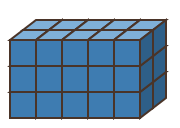 How many unit cubes make this box?
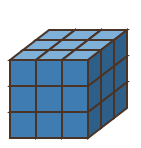 How many unit cubes make this box?
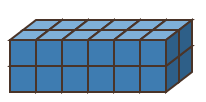 How many unit cubes make this box?
- Read the question.
- Tap your answer.
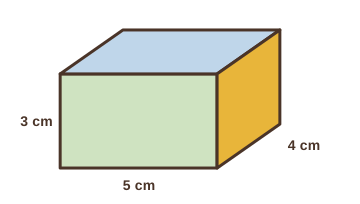
What is the volume of the box in cubic centimeters?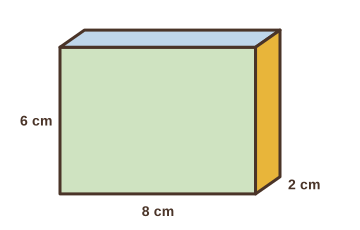 What is the volume of the box in cubic centimeters?
| Statement | True or false? |
|---|---|
| 4 × 3 × 2 = 24 | ? |
| 5 × 4 × 3 = 60 | ? |
| Volume is measured in square units. | ? |
| V = B × h means base area times height. | ? |
Write the three edge lengths in cubes and multiply. Does the product match your count?
Work at the table, not on the floor, so dropped cubes do not get stepped on.
Layers counted, formula found. Tomorrow the cubes do not fit, and the crew needs half cubes.