Thursday
Thursday: The Storage Bins and the Shelf
Raven spreads the Blueprint Book open. "Four bins for the clubhouse. I measured each one twice."
"Which holds the most?" Rocket asks, reaching for the biggest-looking one.
"What do you notice about the straw bin?" Raven says. "Long and thin. Looks can trick you."
Nova hovers above the page. "Multiply before you decide," she says.
Rocket works down the list. "Marker bin, 72. Straw bin, 100. Cube box, 125. Tape bin, 36."
"The cube box wins," he says. "The straw bin is second!"
"Now the shelf," Raven says. "A big box with a small box on top. How much space, and how much cardboard?"
Nova hums. "Two boxes. But some faces are hidden."
Raven's bin table
The crew's own measurements, in centimeters, from the Blueprint Table. Each volume is l × w × h.
| Bin | Length (cm) | Width (cm) | Height (cm) | Volume (cubic cm) |
|---|---|---|---|---|
| Marker bin | 6 | 4 | 3 | 72 |
| Straw bin | 10 | 2.5 | 4 | 100 |
| Cube box | 5 | 5 | 5 | 125 |
| Tape bin | 4.5 | 4 | 2 | 36 |
The straw bin has a fraction edge: 10 × 2 1/2 × 4 = 100. Fraction edges work the same way.
The cube box holds the most, 125 cubic centimeters. The tape bin holds the least, 36.
The L-shaped shelf: a composite solid
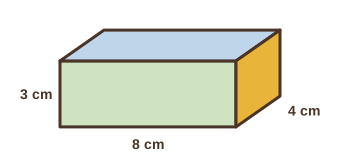
The shelf is two boxes. The big one is 8 by 4 by 3 cm. The small one, 4 by 4 by 3 cm, sits on top.
Volume adds: 96 + 48 = 144 cubic centimeters. Stacking never changes how much space is inside.
Surface area is different. The big box has 136 square cm of faces and the small box has 80.
Where they touch, a 4 by 4 patch is hidden on each box. Take away 2 × 16: 136 + 80 - 32 = 184.
The shelf needs 184 square centimeters of cardboard.
- Read the question.
- Tap your answer.
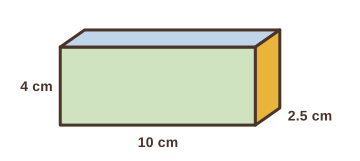 The straw bin is 10 by 2 1/2 by 4 cm. What is its volume in cubic centimeters?
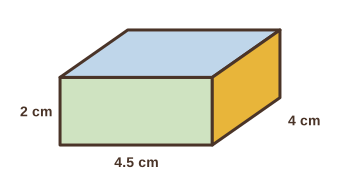 The tape bin is 4 1/2 by 4 by 2 cm. What is its volume in cubic centimeters?
- Read the question.
- Tap your answer.
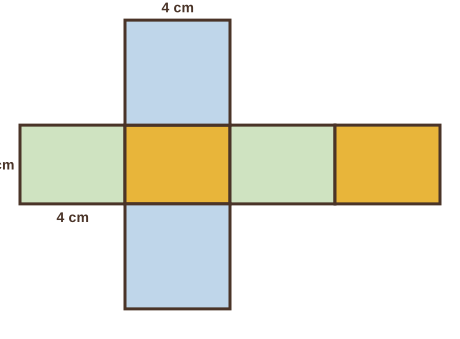 The small box on top is 4 by 4 by 3 cm. What is its surface area alone, in square centimeters?
| From the Blueprint Book | True or false? |
|---|---|
| 96 + 48 = 144 | ? |
| Stacking two boxes changes their total volume. | ? |
| Stacking two boxes hides some faces, so the surface area is less than the two added. | ? |
| 10 × 2 1/2 × 4 = 100 | ? |
Measure both boxes and find the volume and surface area of your stack.
Bins sized, shelf built. Tomorrow you find volume all over the house and review the week.