Friday
Friday: Volume All Around
Rocket walks through the kitchen with a ruler. "That drawer. That cereal box. That shoebox. Everything is a box!"
"Not everything," Raven says, holding up a round can. "What do you notice about this one?"
"No corners," Rocket admits. "Cubes would not pack it."
Nova hovers between them, her light tracing the can's round top. "Save that one for later," she says. "Boxes first."
"Next week we draw the whole garage to scale," Raven says. "Every wall on one sheet of paper."
Rocket looks at the tape measure, then at the garage door. "That is a lot of centimeters."
Nova hums. "That is why we scale."
Boxes at home
| Thing | Edges (cm) | Volume (cubic cm) |
|---|---|---|
| Shoebox | 30 by 18 by 12 | 6,480 |
| Cereal box | 20 by 6 by 30 | 3,600 |
| Drawer | 40 by 35 by 10 | 14,000 |
| Small gift box | 7 1/2 by 6 by 4 | 180 |
These are the crew's measurements of things at the Blueprint Table, not standard sizes. Yours will differ.
Any box-shaped space works the same way: three edges, one product. Fraction edges are no harder than whole ones.
A round can is not a box. Its volume waits for the circle week and the round solids week.
How to find any box's volume
- Measure the three edges in the same unit.
- Multiply the three edges, or multiply the base area by the height.
- Write the answer in cubic units: cubic centimeters for centimeter edges.
- For stacked boxes, add the volumes. For their surface area, take away the hidden faces.
- Read the question.
- Tap your answer.
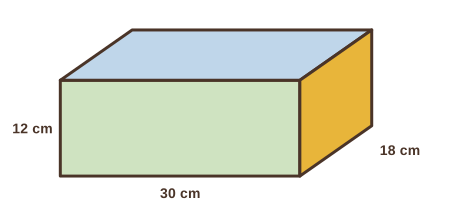 The shoebox is 30 by 18 by 12 cm. What is its volume in cubic centimeters?
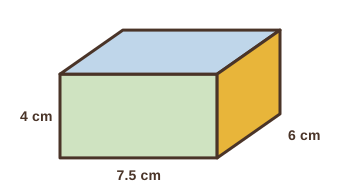 The gift box is 7 1/2 by 6 by 4 cm. What is its volume in cubic centimeters?
- Read the question.
- Tap your answer.
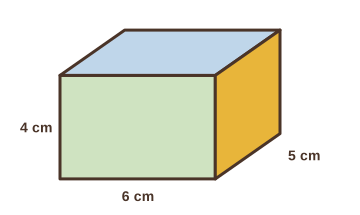 What is the volume of the box in cubic centimeters?
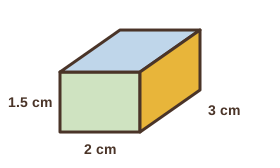 What is the volume of the box in cubic centimeters?
| Week review | True or false? |
|---|---|
| 4 × 3 × 2 = 24 | ? |
| 2 × 2 × 2 = 8 | ? |
| 72 ÷ 8 = 9 | ? |
| A box with a fraction edge cannot use V = l × w × h. | ? |
| Two stacked boxes have the sum of their volumes. | ? |
- ?We packed half cubes into a box with a fraction edge and got the same volume.
- ?We packed a bin with unit cubes and found V = l × w × h and V = B × h.
- ?We sized four bins and stacked two boxes into an L-shaped shelf.
- ?We ran Build Lab, predicting and counting three boxes.
Write them in your Blueprint Book from smallest to largest.
A week of cubes and layers. Tomorrow is Build Day: pack a family box and size the clubhouse bins.