Tuesday
Tuesday: Perimeter, Area and Four Quadrants
Raven moves the origin tape to the middle of the floor. "Now the grid goes left and down too. Negative numbers."
"The storage wall starts at (-3, 2) and runs to (4, 2)," Rocket reads. "Same y. So it is horizontal."
"How long?" Raven asks. "What do you notice about going from -3 to 4?"
Rocket counts on the tape lines. "Three to get to zero, four more. Seven squares."
"Four minus negative three," Raven says. "Also seven. Subtracting works across zero too."
Nova hovers above the origin, her light splitting the floor into four quadrants. "Name where each corner lives," she says.
"(-3, 2) is up and left," Rocket says. "Quadrant two." Nova hums. "Now the perimeter. Add every wall."
From side lengths to perimeter and area
Perimeter is the distance all the way around: add every side. Area for a rectangle is length × width.
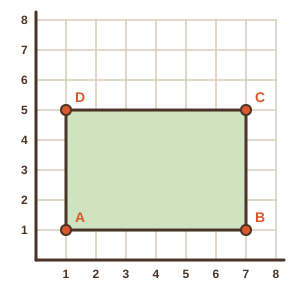
The main room (1, 1), (7, 1), (7, 5), (1, 5) has sides 6 and 4. Perimeter: 6 + 4 + 6 + 4 = 20 units.
Area: 6 × 4 = 24 square units. For an L shape, cut it into rectangles first, as in week 1.
Four quadrants
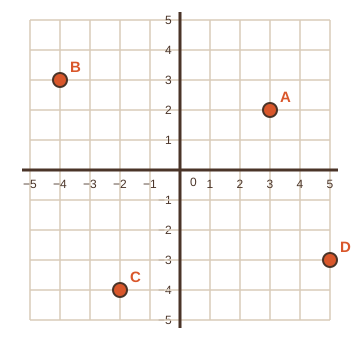
The x-axis and y-axis cross at the origin (0, 0) and cut the plane into four quadrants.
Quadrant I is upper right, both coordinates positive. Quadrant II is upper left, x negative. Quadrant III is lower left, both negative. Quadrant IV is lower right, y negative.
Point A (3, 2) is in Quadrant I. Point B (-4, 3) is in Quadrant II. The numbering goes counterclockwise.
Lengths across zero
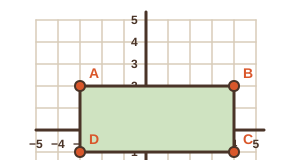
The storage wall runs from (-3, 2) to (4, 2). Same y, so subtract the x-coordinates: 4 - (-3) = 7.
The side from (4, 2) to (4, -1) has the same x. Its length is 2 - (-1) = 3.
Subtracting a negative number adds its distance. Counting the squares on the floor gives the same answer.
| Step | What to do | Main room example |
|---|---|---|
| 1 | Plot the vertices and join them in order. | (1, 1), (7, 1), (7, 5), (1, 5) |
| 2 | Pair up points that share a coordinate. | A and B share y = 1; B and C share x = 7 |
| 3 | Subtract the other coordinates for each side. | 7 - 1 = 6; 5 - 1 = 4 |
| 4 | Add the sides for perimeter; multiply for a rectangle's area. | perimeter 20, area 24 |
- Read the question.
- Tap your answer.
- Read the question.
- Tap your answer.
Point A is at (3, 2). Which quadrant is it in?Point B is at (-4, 3). Which quadrant is it in?Point C is at (-2, -4). Which quadrant is it in?Point D is at (5, -3). Which quadrant is it in?- Read the question.
- Tap your answer.
 The main room has vertices (1, 1), (7, 1), (7, 5), (1, 5). What is its perimeter in units?What is the area of the main room in square units?The storage wall outline has vertices (-3, 2), (4, 2), (4, -1), (-3, -1). What is its perimeter in units?What is the area inside the storage wall outline, in square units?
- ?Subtract the x-coordinates: 4 - (-3) = 7.
- ?Pair the points that share an x and subtract the y-coordinates: 2 - (-1) = 3.
- ?Pair the points that share a y: the horizontal sides.
- ?Add all four sides: 7 + 3 + 7 + 3 = 20.
Find each side by subtracting, then count squares to check. Name the quadrant of each corner.
Sides, perimeter and area, all from coordinates. Tomorrow is Build Lab: string polygons on the real floor grid.