Wednesday
Wednesday: Build Lab, String Walls
Raven kneels at the origin of the floor grid with a ball of string. "Build Lab. Coordinates against the tape measure."
"Each square is 30 centimeters," Rocket says. "I measured the tape lines twice."
"Lay out a rectangle from (0, 0) to (5, 3)," Raven says. "Predict every wall from the coordinates. Then measure with the tape."
"Five squares is 150 centimeters," Rocket says, already unrolling string. "Three squares is 90."
Nova hovers above the taut string. "Measure the string, not the tape lines," she says. "Then compare."
Rocket stretches the tape measure along the front wall and reads. "One hundred fifty. Exactly." Nova hums. "What do you notice?"
Your mission
Lay out two string polygons on a taped floor grid. Predict every side length from the coordinates, then measure each side with the tape measure.
- Masking tape and a tape measure. Tape lines every 30 cm make a grid of squares.
- A ball of string, scissors, and small pieces of tape to pin the corners.
- Your Blueprint Book for the data table.
Shoes on in the garage. A grown-up holds the tape measure and lets it rewind slowly.
Cut string with scissors only, with a grown-up nearby. Pick up every piece when you finish.
- Tape the x-axis and the y-axis across the floor. Mark every 30 cm along each with a short tape mark.
- Pin string at (0, 0), (5, 0), (5, 3), (0, 3) and back to the start. Predict each wall in squares, then in centimeters.
- Measure each string wall with the tape measure. Write the measurement next to the prediction.
- Now pin an L shape: (0, 0), (6, 0), (6, 2), (2, 2), (2, 4), (0, 4). Predict all six sides, then measure.
- Add the sides for the perimeter of each shape. Count the squares inside for the area.
The crew's lab table
These are the crew's own string walls, with one square equal to 30 cm, from Raven's Blueprint Book.
| Wall | From | To | Predicted (squares) | Measured (cm) |
|---|---|---|---|---|
| 1 | (0, 0) | (5, 0) | 5 | 150 |
| 2 | (5, 0) | (5, 3) | 3 | 90 |
| 3 | (5, 3) | (0, 3) | 5 | 150 |
| 4 | (0, 3) | (0, 0) | 3 | 90 |
Every wall measured exactly 30 cm per predicted square. The rectangle's perimeter is 16 squares, or 480 cm.
The L shape had six walls and a perimeter of 20 squares. Its area, counted inside the string, was 16 squares.
- Read the question.
- Tap your answer.
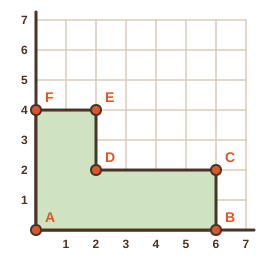 The L shape has vertices (0, 0), (6, 0), (6, 2), (2, 2), (2, 4), (0, 4). What is its perimeter in squares?How many squares does the L shape enclose?
| What the lab shows | True or false? |
|---|---|
| The tape measure agreed with the coordinate subtraction for every wall. | ? |
| 5 × 30 = 150 | ? |
| An L shape with six vertices has four sides. | ? |
String, tape and coordinates all agreed. Tomorrow the crew lays out every wall of the clubhouse from Raven's plan.