Monday
Monday: Corners With Names
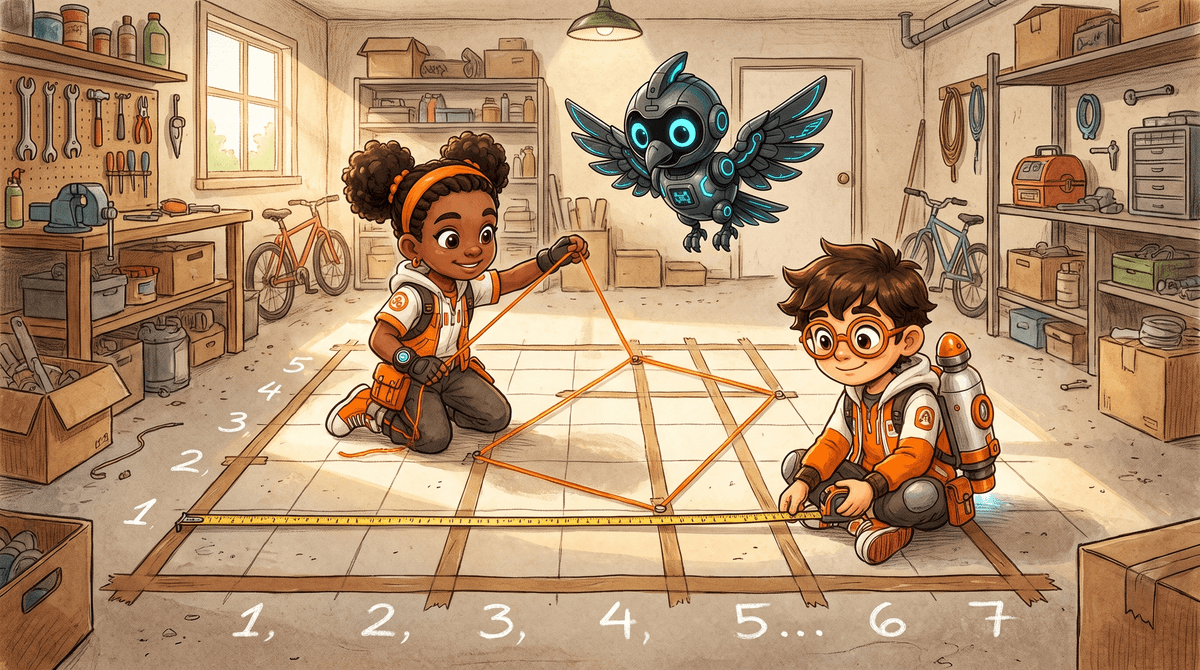
Rocket is on his knees with masking tape, laying lines across the garage floor. "A grid. One square is one floor tile."
"Every corner of the clubhouse gets a name," Raven says. "Two numbers. Across, then up."
She reads from the Blueprint Book. "Main room: (1, 1), (7, 1), (7, 5), (1, 5)."
Rocket runs string from corner to corner. A rectangle appears on the floor. "How long is the front wall?"
"What do you notice about (1, 1) and (7, 1)?" Raven asks.
"Same up number," Rocket says. "So the wall runs straight across. From 1 to 7. Six squares."
Nova hovers above the string, her light sliding along the front wall. "You did not need the tape measure," she says. "Only the coordinates."
A point is two numbers
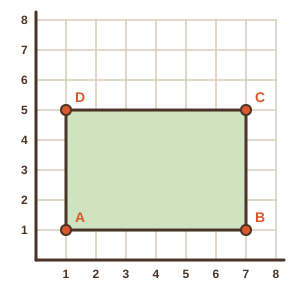
Every point on the grid has coordinates (x, y). The x-coordinate says how far across from the origin, the y-coordinate how far up.
The main room has vertices A (1, 1), B (7, 1), C (7, 5) and D (1, 5). Join them in order and you get a rectangle.
A vertex is a corner. To draw a polygon from its vertices, plot each point, then join them in the order given.
Same coordinate, straight side
A (1, 1) and B (7, 1) have the same y-coordinate, 1. The side AB is horizontal. Its length is the difference of the x-coordinates: 7 - 1 = 6.
B (7, 1) and C (7, 5) have the same x-coordinate, 7. The side BC is vertical. Its length is 5 - 1 = 4.
Same x means a vertical side. Same y means a horizontal side. Subtract the coordinates that differ, and you have the length.
- Read the question.
- Tap your answer.
- Read the question.
- Tap your answer.
| Statement | True or false? |
|---|---|
| In (7, 1), the 7 is the x-coordinate, the steps across. | ? |
| Two points with the same x-coordinate make a horizontal side. | ? |
| 7 - 1 = 6 | ? |
| A vertex is a corner of a polygon. | ? |
Find each side length by subtracting coordinates. Then count squares along each side to check.
Shoes on in the garage. Pick up loose string and tape when you are done.
Corners named, walls measured. Tomorrow you find perimeter and area from the coordinates, and cross into all four quadrants.