Wednesday
Wednesday: Shop Lab, the Honeycomb Panel
Comet holds a cardboard hexagon against the panel. "Side 10. I measured center to edge: 8.7. Why do these fit so well?"
"Look at a corner where three meet," Wren says. "What do you notice?"
"Three angles, no gap." She checks with the protractor. "Each one is 120. Three of them make 360."
Nova projects three pentagons around one point. A thin wedge of empty space shows. "Would you like a hint? Try 108 three times."
"324. A gap," Comet says. "So pentagons leave holes and hexagons do not. What can we make of the whole panel?"
"We counted 114 tiles on it," Wren says. "Our designer, find a tile's area and check the count."
What you need
- Cardboard or thick paper, a ruler, a protractor, a pencil and scissors.
- A sheet of paper or a tray to tile, about the size of a placemat.
- Your Shop Book.
Keep offcuts in a pile so the floor stays clear. Nothing heavy is moved alone.
Run the lab
- Draw a regular hexagon with 5 cm sides: six 60 degree turns of the protractor around a center point.
- Cut it out with scissors and use it as a template to cut nine more.
- Measure the apothem: from the center straight to the middle of one side. Write it down.
- Tile the tray. Put three tiles around one corner and check that no gap shows.
- Count how many tiles cover the tray. Measure the tray. Find the tiles per square unit.
- Compute one tile's area: six triangles, each half of side times apothem. Multiply by the count and compare with the tray.
The crew's panel data
The crew's own tile: side 10 cm, apothem 8.7 cm as measured. The panel is 2 m by 1.5 m.
| Measure | Value |
|---|---|
| interior angle of a regular hexagon | 120° |
| angles meeting at one corner | 3 × 120° = 360°, no gap |
| interior angle of a regular pentagon | 108°, and 3 × 10⁸° leaves a gap |
| one triangle of the tile | half of 10 × 8.7 = 43.5 square cm |
| one tile (six triangles) | 261 square cm |
| tiles counted on the panel | 114 |
| area the tiles cover | 114 × 261 = 29,754 square cm |
| area of the panel | 30,000 square cm |
The tiles cover 29,754 square centimeters of a 30,000 square centimeter panel. The small difference is the trimmed edge tiles.
A regular hexagon tiles with no gaps because its interior angle divides 360 exactly. A pentagon's does not.
- Read the question.
- Tap your answer.
- Read the question.
- Tap your answer.
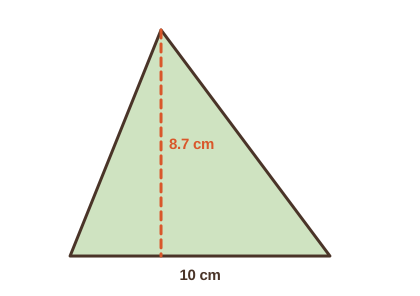 One of the six triangles in the tile has base 10 cm and height 8.7 cm. What is its area in square centimeters?
| What the lab shows | True or false? |
|---|---|
| Three regular hexagons meet at a corner with no gap. | ? |
| Three regular pentagons meet at a corner with no gap. | ? |
| Four squares meet at a corner with no gap. | ? |
| The apothem runs from the center to a corner of the hexagon. | ? |
Careful tiling, designer. Tomorrow the crew designs under constraints: the least fabric and the most seats.