Friday
Friday: Opening Night
The house lights dim. Comet and Wren stand at the back of the theater as the curtain rises on their set.
The column stands straight. The turntable turns. The lamp dish throws a clean beam across the honeycomb panel.
"Twelve weeks," Comet whispers. "Chalk and string, flats that slide and flip, the braces, the ramp, the circle."
"Shadows and the pole, the stage grid, the pouring test," Wren adds. "What do you notice? Nothing wobbles."
Nova hovers at the rail, her light low. "Would you like a hint? Every piece out there is a measurement you checked."
Comet grins. "What can we make next?" Wren opens the clipboard to a clean page. "Our designer, review the course. Then run your own Shop Day."
The set, piece by piece
| Piece | Week | The geometry that made it work |
|---|---|---|
| the chalk grid and the arcs | 1 | definitions and compass constructions |
| the flats that slide and flip | 2 and 3 | rigid motions and congruence |
| the parallelogram frame | 4 | proofs about lines, angles and parallelograms |
| the scale model and the shadows | 5 and 6 | dilations and similar triangles |
| the ramp and the rigging | 7 | right-triangle trigonometry |
| the turntable and the spotlight | 8 | circles: angles, arcs and sectors |
| the stage grid | 9 and 10 | coordinates, equations of circles and parabolas |
| the foam props and the paint | 11 | volume: where the formulas come from |
| the honeycomb panel and the seats | 12 | modeling, density and design |
The week in five lines
- A model is the simple shape closest to an object, with only the measures that matter.
- Density is an amount divided by the space it fills, by area or by volume.
- Multiply a density by a new space to predict; divide an amount by its space to check.
- A regular hexagon tiles with no gaps because 3 × 120 = 360.
- A design problem has constraints. Geometry turns each option into a number so the best one can be chosen.
- Read the question.
- Tap your answer.
- Read the question.
- Tap your answer.
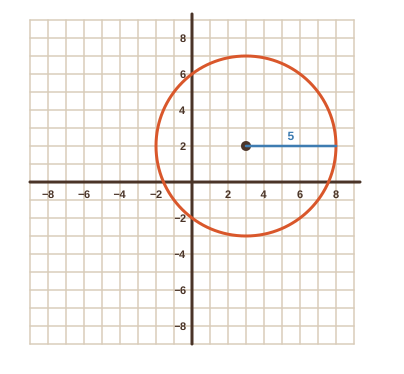 The turntable has center (3, 2) and radius 5 on the stage grid. Which equation describes it?
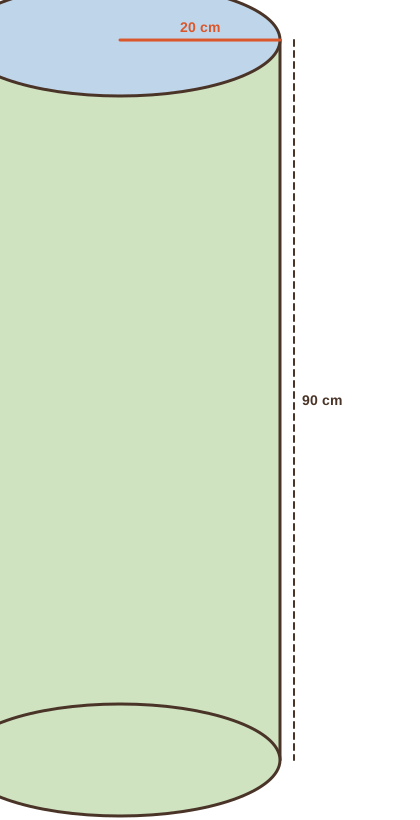 The column: radius 20 cm, height 90 cm. What is its volume in cubic centimeters? Use 3.14 for π.
| Course review | True or false? |
|---|---|
| A chipped column can still be modeled as a cylinder. | ? |
| Seats per square meter is a density by volume. | ? |
| Three regular pentagons meet at a corner with no gap. | ? |
| Doubling every length of a backdrop multiplies its area by 4. | ? |
| A cone holds one third of the cylinder with the same base and height. | ? |
| The equation (x - 3)² + (y - 2)² = 25 has radius 25. | ? |
The curtain is up, designer. Tomorrow is your Shop Day: a model, a plan and a volume check, run at home.