Wednesday
Wednesday: Shop Lab, the Pouring Test
Comet sets a paper cup on a tray and rolls a sheet of paper into a cone beside it. "Same base, same height. Promise."
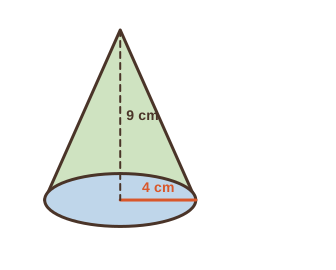
Wren checks with the ruler. "Cup radius 4, height 9. Cone radius 4, height 9. Okay. What does the evidence say?"
Comet fills the cone with water from the jug and pours it into the cup. The level climbs a third of the way.
"Again," Wren says. Two thirds. "Again." The cup fills to the brim and not a drop over.
"Three cone-fulls," Comet says. "What can we make of that? The cone really is a third."
Nova projects the two volumes side by side. "Would you like a hint? Check the formulas against the pour."
"Our designer, run it yourself," Wren says. "Water on a tray, and measure before you pour."
What you need
- A paper cup, a sheet of paper, tape and scissors.
- A jug of water, a tray or a baking pan to catch spills, and a towel.
- A ruler, a marker and your Shop Book.
Scissors only, sitting down, on paper. Nothing is tasted, and the water goes back to the sink after.
Nothing heavy is lifted alone. A grown-up fills the jug if it is large.
Run the lab
- Measure the cup: the radius of its opening and its height. Write both down.
- Roll the paper into a cone whose opening matches the cup. Tape it and trim it to the cup's height with scissors.
- Fill the cone to the brim with water and pour it into the cup. Mark the water level on the cup.
- Fill the cone again and pour again. Mark the new level. Repeat until the cup is full.
- Count the pours. Measure the height of each mark from the bottom of the cup.
- Compute both volumes with the formulas and compare their ratio with your count.
The crew's pouring log
These are the crew's own measurements: cup radius 4 cm and height 9 cm, the cone the same.
| Pour | Water level in the cup (cm) | Fraction of the cup |
|---|---|---|
| 1 | 3 | 1/3 |
| 2 | 6 | 2/3 |
| 3 | 9 | full |
By the formulas: cup 452.16 cubic centimeters, cone 150.72 cubic centimeters. Use 3.14 for π.
The ratio is 3, and the crew counted 3 pours. The water agrees with the one third.
- Read the question.
- Tap your answer.
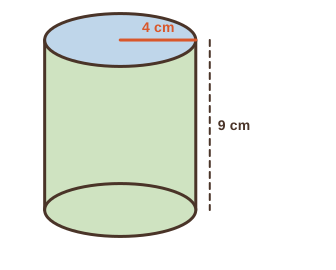 The paper cup is a cylinder with radius 4 cm and height 9 cm. What is its volume in cubic centimeters? Use 3.14 for π.The paper cone has radius 4 cm and height 9 cm. What is its volume in cubic centimeters? Use 3.14 for π.
| What the lab shows | True or false? |
|---|---|
| The cone and the cup must have the same base and height for the test to work. | ? |
| After two pours the cup is half full. | ? |
| Three cone-fulls fill the cup exactly. | ? |
| A taller cone with the same base would still need three pours. | ? |
Careful pouring, designer. Tomorrow the crew's prop table puts every formula to work.