Tuesday
Tuesday: The One Third
Wren sets a foam cube on the bench, edge 30 centimeters. "Comet, you said the pyramid is a third of this. Why?"
"Because the formula says so," Comet says, then stops. "That is not a reason, is it?"
Nova projects the cube with lines from one corner to the four corners of the far faces. "Would you like a hint? Count the pieces."
"Three pyramids," Wren says. "Each one has a face of the cube as its base and the far corner as its tip."
"And they are identical," Comet says, turning the picture. "So each is one third of the cube. What can we make of the cone?"
"The same idea, but tomorrow we test it with water," Wren says. "Our designer, the formulas are Bh over 3 and πr²h over 3."
Three pyramids in a cube
Pick one corner of a cube. Join it to the four corners of each of the three faces that do not touch it.
That cuts the cube into three pyramids. Each has a square face as its base, the cube edge as its height, and the far corner as its apex.
The three pyramids are identical, so each has one third of the cube. For the crew's cube, edge 30: 27,000 ÷ 3 = 9,000 cubic centimeters.
A pyramid with base area B and height h has volume Bh/3. A cone is a pyramid with a round base, so its volume is πr²h/3.
| Solid | Volume formula | What it comes from |
|---|---|---|
| prism | Bh | a stack of identical slices |
| cylinder | πr²h | a stack of identical discs |
| pyramid | Bh/3 | three pyramids fill the matching prism |
| cone | πr²h/3 | three cone-fulls fill the matching cylinder |
| sphere | 4/3 πr³ | a formula we use this week; its argument waits for a later course |
- Name the solid and write its formula.
- Find the base area B, or πr² for a round base. Use 3.14 for π.
- Multiply by the height.
- Divide by 3 for a pyramid or a cone. Write the unit: cubic centimeters.
Two methods, one answer
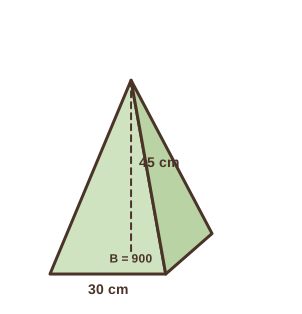
Take the foam pyramid, base 30 by 30 and height 45. The matching prism is 900 × 45 = 40,500. A third of that is 13,500.
Or divide first: 45 ÷ 3 = 15, then 900 × 15 = 13,500. Dividing the height by 3 or dividing the product by 3 gives the same number.
- Read the question.
- Tap your answer.
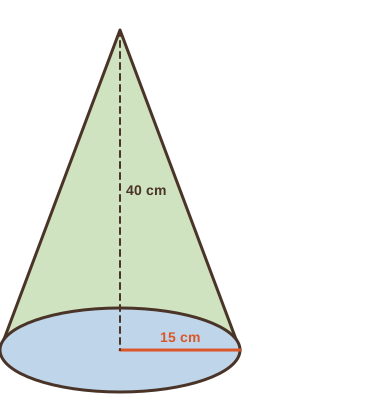
The foam pyramid has base area 900 square centimeters and height 45 cm. What is its volume in cubic centimeters?The foam cone has radius 15 cm and height 40 cm. What is its volume in cubic centimeters? Use 3.14 for π.- Read the question.
- Tap your answer.
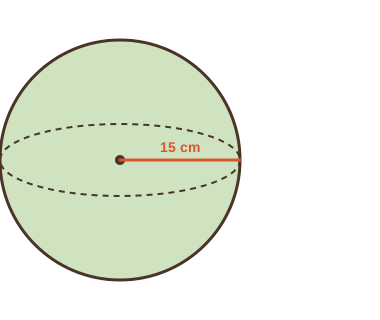 The foam ball has radius 15 cm. What is its volume in cubic centimeters? Use 3.14 for π.
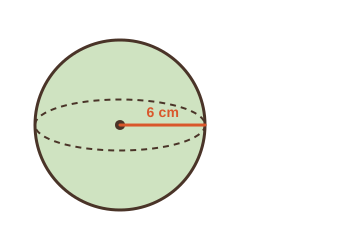 A small foam ball has radius 6 cm. What is its volume in cubic centimeters? Use 3.14 for π.
- ?Divide by 3: 9,420 cubic centimeters
- ?Multiply by 3.14 for the base area: 706.5
- ?Square the radius: 15 × 15 = 225
- ?Multiply by the height 40: 28,260
Shade one pyramid. Can you see all three?
Clear reasoning, designer. Tomorrow is Shop Lab: the pouring test with a paper cone and a paper cup.