Thursday
Thursday: The Prop Table
Wren pins a page to the corkboard: five props, five shapes, five volumes. "Everything we carved this month."
"The column is the big one," Comet says, scanning it. "What do you notice about the ball and the pyramid?"
"Close," Wren says. "The ball is a bit bigger, and it is only 15 across each way from the center."
"Spheres are sneaky," Comet says. "The r is cubed. What can we make of the scrap from the ball?"
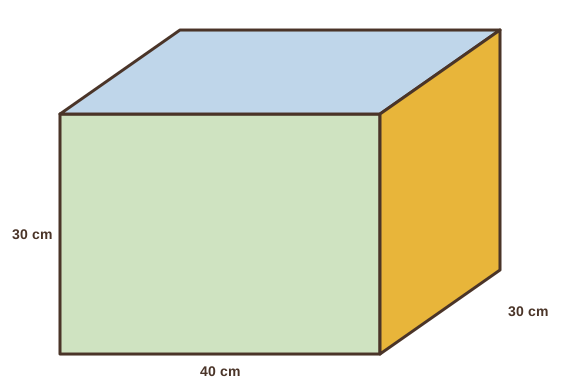
Nova projects the foam block the ball was carved from, a box 40 by 30 by 30. "Would you like a hint? Box minus ball."
"And the model props are half size," Wren says. "Every length doubles to full size. Our designer, what happens to the volume?"
"Not double," Comet says. "Work it out and see."
The crew's prop volumes
Every number here is the crew's own Scene Shop measurement in centimeters. Volumes use 3.14 for π.
| Prop | Shape | Measurements (cm) | Volume (cubic cm) |
|---|---|---|---|
| column | cylinder | r = 20, h = 90 | 113,040 |
| foam pyramid | square pyramid | base 30 by 30, h = 45 | 13,500 |
| foam cone | cone | r = 15, h = 40 | 9,420 |
| foam ball | sphere | r = 15 | 14,130 |
| stair unit | prism | B = 1200, h = 40 | 48,000 |
The column has the largest volume, 113,040 cubic centimeters.
The foam ball was carved from a box 40 by 30 by 30. Box 36,000 minus ball 14,130 leaves 21,870 cubic centimeters of scrap.
Scaling a prop
The crew's model props are half size. Doubling every length doubles the radius, doubles the height, and doubles the depth.
Three lengths multiply in a volume, so the volume is multiplied by 2 × 2 × 2 = 8. A model cone of 1,177.5 cubic centimeters becomes 9,420 at full size.
- Read the question.
- Tap your answer.
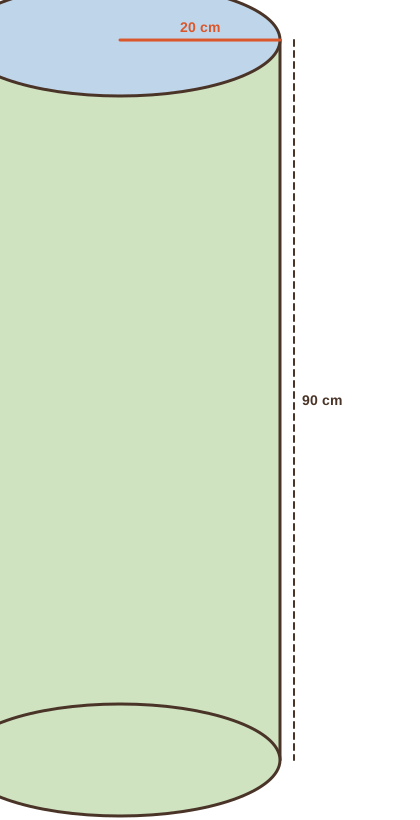 The column: radius 20 cm, height 90 cm. What is its volume in cubic centimeters? Use 3.14 for π.
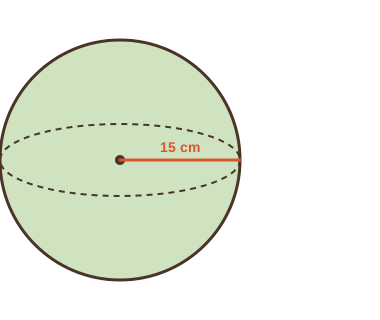 The foam ball: radius 15 cm. What is its volume in cubic centimeters? Use 3.14 for π.
- Read the question.
- Tap your answer.
| Statement | True or false? |
|---|---|
| The foam ball has a larger volume than the foam pyramid. | ? |
| Doubling every length doubles the volume. | ? |
| Doubling every length multiplies the volume by 8. | ? |
| The cone and the pyramid together have more volume than the stair unit. | ? |
Sharp reading, designer. Tomorrow you slice solids, spin flat shapes and review the week.