Monday
Monday: Wedges and Stacked Discs
Comet rolls the bolt of backdrop fabric to the end of the bench to clear a space. "Column next. It needs filling."
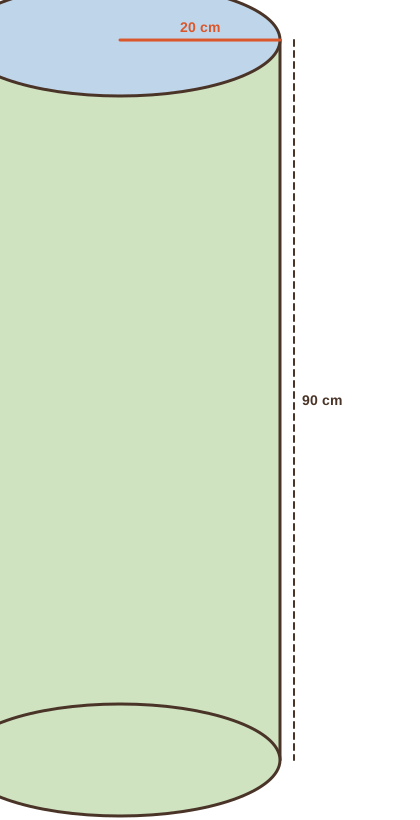
Wren stands the cardboard column on the plywood row and reads the tape. "Radius 20, height 90. How much foam fits inside?"
"Base area times height," Comet says. "What can we make of the base? It is a circle, so πr²."
"But why is a circle πr²?" Wren asks. "What do you notice if you cut one into wedges?"
Nova projects a circle slicing itself into sixteen thin wedges, then lays them tip to tail. "Would you like a hint?"
"It is almost a parallelogram," Comet says. "Half the circumference along the bottom, the radius for the height."
"πr times r," Wren says. "Then stack discs to the top. Our designer, that is the whole formula."

Where πr² comes from
Cut a circle into many thin wedges and lay them in a row, points up, points down. The row is almost a parallelogram.
Its base is half the circumference, πr. Its height is the radius, r. So the area is πr × r = πr².
With more and thinner wedges the bumpy edge flattens out. That is an informal limit argument: the fit gets as close as you like.
Where πr²h comes from
A cylinder is a stack of thin discs, each the same circle. Every disc adds the same area, so the volume is base area times height.
Pushing the stack sideways into a leaning tower does not change the volume. Same discs, same heights, same volume.
A solved problem to study
Comet works out the column. Base area: 3.14 × 20 × 20 = 1,256 square centimeters. Use 3.14 for π.
Volume: 1,256 × 90 = 113,040 cubic centimeters of foam.
Why does this work? Each 1 centimeter slice of the column is a disc with that base area. Ninety slices stack to the top.
- Read the question.
- Tap your answer.
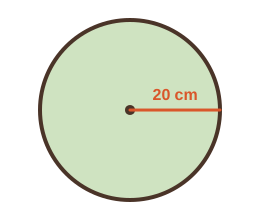 The column's base has radius 20 cm. What is its circumference in centimeters? Use 3.14 for π.The column's base has radius 20 cm. What is its area in square centimeters? Use 3.14 for π.The column is a cylinder with radius 20 cm and height 90 cm. What is its volume in cubic centimeters? Use 3.14 for π.
- Read the question.
- Tap your answer.
| Statement | True or false? |
|---|---|
| Thinner wedges make the row closer to a true parallelogram. | ? |
| The height of the wedge parallelogram is the diameter. | ? |
| The volume of a cylinder is base area times height. | ? |
| Leaning a stack of discs sideways changes its volume. | ? |
| The column holds more than 100000 cubic centimeters of foam. | ? |
Try sixteen wedges. Which row looks more like a parallelogram?
Strong start, designer. Tomorrow a cube splits into three pyramids and the cone learns its one third.