Wednesday
Wednesday: Shop Lab, Four Marks on the Floor
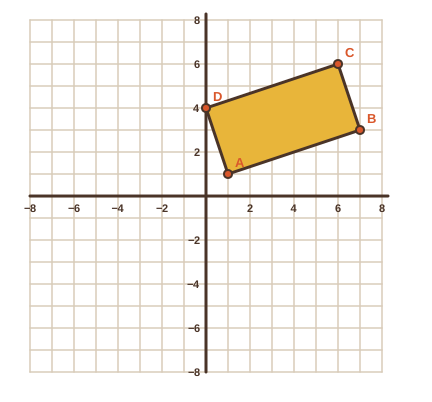
Comet drops four strips of tape on the grid. "The platform corners. (1, 1), (7, 3), (6, 6), (0, 4)."
"The platform is supposed to be a rectangle," Wren says. "Does it look like one?"
"It looks tilted," Comet says. "But tilted is fine. Square corners are what matter. What can we test?"
"Slopes for the corners. Distances for the sides," Wren says. "And the diagonals should match."
Nova projects the four marks joined into a quadrilateral. "Would you like a hint? Start with AB and BC."
"AB has slope 1/3, BC has slope -3," Comet says. "Product -1. One square corner."
"Three to go," Wren says. "Our designer, run the lab on paper first, then on your own floor."
What you need
- Graph paper and a pencil for the paper test, with a ruler and a protractor to check.
- For the floor test: masking tape, a tape measure, and a clear floor at least 2 meters by 2 meters.
- A carpenter's square or a hardcover book for checking corners. Your Shop Book.
Move only light things to clear the floor. Nothing heavy is lifted alone, and a grown-up moves furniture.
Measure with a tape measure, never a sharp tool. Cutting tape is scissors only.
Run the lab
- Plot the crew's four marks on graph paper and join them in order: A, B, C, D, back to A.
- Find the slope of each side. Check that opposite sides have equal slopes.
- Multiply the slopes of two sides that meet. Is the product -1 at every corner?
- Find the length of each side and of both diagonals with the distance formula.
- On your floor, tape a corner as the origin and two tapes as axes. Lay four marks of your own and test them the same way.
The crew's lab log
Here are the crew's own numbers for the four platform marks, all made-up stage-grid data in meters.
| Side | Points | Slope | Length (m) |
|---|---|---|---|
| AB | (1, 1) to (7, 3) | 1/3 | 6.32 |
| BC | (7, 3) to (6, 6) | -3 | 3.16 |
| CD | (6, 6) to (0, 4) | 1/3 | 6.32 |
| DA | (0, 4) to (1, 1) | -3 | 3.16 |
Opposite sides: AB and CD both have slope 1/3; BC and DA both have slope -3. Two pairs of parallel sides.
Corners: 1/3 × -3 = -1, so every corner is a right angle.
Diagonals: AC is about 7.07 meters and BD is about 7.07 meters. Equal, as a rectangle's diagonals must be (week 4).
Wren also tested (1, 1), (7, 3), (8, 7), (2, 5). Opposite sides are parallel, so it is a parallelogram.
But AB has slope 1/3 and BC has slope 4. Their product is not -1, so the corner is not square.
The diagonals give it away too: 9.22 and 5.39 meters. A parallelogram with unequal diagonals is not a rectangle.
- Read the question.
- Tap your answer.
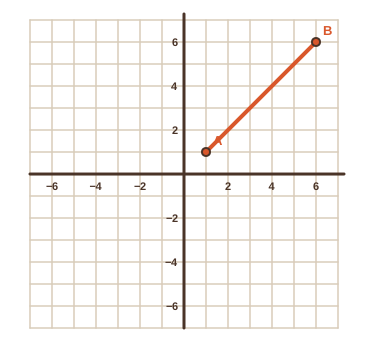 How long is the diagonal AC, from (1, 1) to (6, 6), in meters?
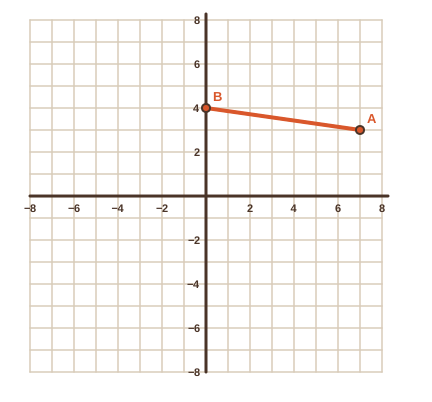 How long is the diagonal BD, from (7, 3) to (0, 4), in meters?
| What the lab shows | True or false? |
|---|---|
| Opposite sides of the platform have equal slopes. | ? |
| The product of the slopes at corner B is -1. | ? |
| A tilted rectangle on the grid is not really a rectangle. | ? |
| Wren's second set of marks, with diagonals 9.22 and 5.39, is a rectangle. | ? |
Test them with slopes and diagonals. Then check one corner with the carpenter's square. Do the tests agree?
Fine lab work, designer. Tomorrow is Proof Day: the rectangle test becomes a proof, step by step.