Thursday
Proof Day: The Platform Is a Rectangle
"Yesterday the numbers said rectangle," Wren says, pinning the lab log to the corkboard. "Today we write the proof."
"Given: four marks with coordinates," Comet says. "To prove: they make a rectangle. What goes first?"
"Parallel sides, from the slopes. That makes it a parallelogram," Wren says. "Then one right angle."
"Why only one?" Comet asks. "We checked all four yesterday."
Nova projects the parallelogram with one corner glowing. "Would you like a hint? Week 4: consecutive angles of a parallelogram."
"They add to 180," Comet says. "So one right angle forces the rest. Nice."
"Then the diagonals as a check," Wren says. "Our designer, put the steps in order and finish it."
The claim
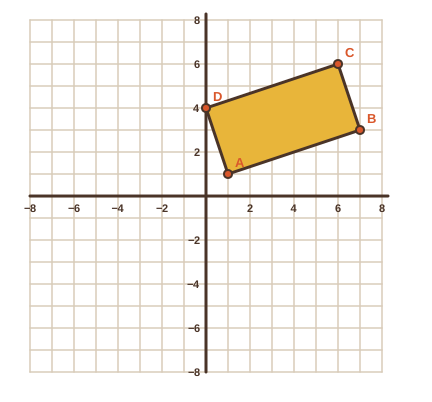
Given: A (1, 1), B (7, 3), C (6, 6) and D (0, 4) on the stage grid.
To prove: ABCD is a rectangle.
The proof, read first
- Slope of AB = 1/3 and slope of DC = 1/3. Equal slopes, so AB is parallel to DC.
- Slope of BC = -3 and slope of AD = -3. Equal slopes, so BC is parallel to AD.
- Both pairs of opposite sides are parallel, so ABCD is a parallelogram.
- Slope of AB × slope of BC = 1/3 × -3 = -1, so AB is perpendicular to BC. Angle B is a right angle.
- Consecutive angles of a parallelogram add to 180° (week 4), so every angle of ABCD is a right angle.
- Therefore ABCD is a rectangle.
Check: a rectangle's diagonals are equal. AC = 7.07 and BD = 7.07, both the square root of 50. They match.
A coordinate proof is the same proof as week 4, with slopes standing in for parallel marks and distances for tick marks.
A point on a circle
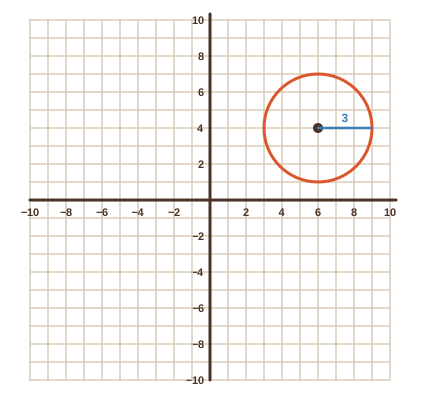
The turntable's center is at (6, 4) and its radius is 3 meters. Is the mark (9, 4) on its rim? Its distance from the center is 3. Yes.
Is (8, 6) on the rim? Its distance from the center is the square root of 8, about 2.83. Not 3, so no.
A point is on a circle exactly when its distance from the center equals the radius. That is a one-line coordinate proof.
- ?Slope of AB = slope of DC = 1/3, so AB is parallel to DC
- ?Therefore ABCD is a rectangle
- ?Both pairs of opposite sides are parallel, so ABCD is a parallelogram
- ?Slope of BC = slope of AD = -3, so BC is parallel to AD
- ?Consecutive angles of a parallelogram add to 180°, so every angle is a right angle
- ?Slope of AB × slope of BC = -1, so angle B is a right angle
- Read the question.
- Tap your answer.
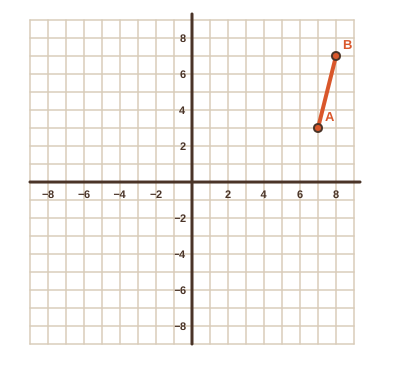 In Wren's failed set, BC runs from (7, 3) to (8, 7). What is its slope?
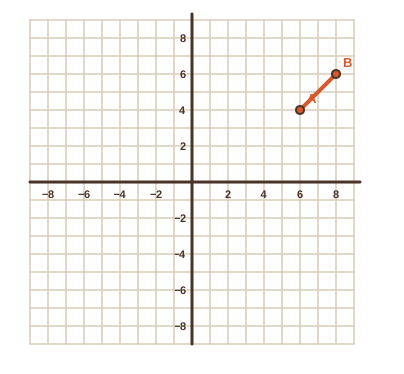 How far is the mark (8, 6) from the turntable center (6, 4)?
| Statement | True or false? |
|---|---|
| A parallelogram with one right angle is a rectangle. | ? |
| Equal diagonals alone prove that any quadrilateral is a rectangle. | ? |
| A point is on a circle when its distance from the center equals the radius. | ? |
| The point (8, 6) lies on the turntable's rim. | ? |
Clear reasoning, designer. Tomorrow you measure perimeters and areas straight from coordinates, then review the week.