Tuesday
Tuesday: Parallel and Perpendicular by Slope
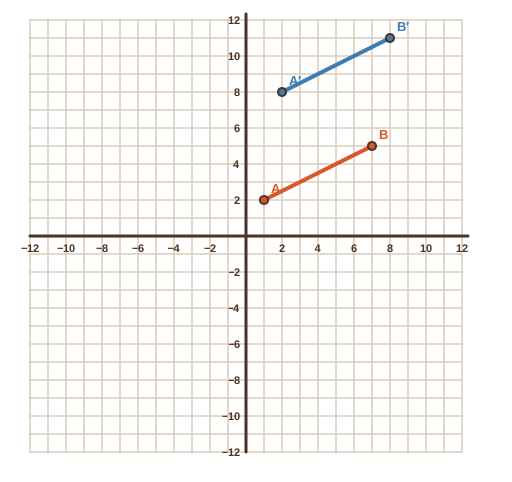
Wren crouches over two taped edges. "Flat 1 runs from (1, 2) to (7, 5). Flat 2 from (2, 8) to (8, 11)."
"Both slopes are 0.5," Comet says. "Same tilt. Parallel, without a protractor."
"And the brace tape, (4, 9) to (6, 5)?" Wren asks. "What do you notice about its slope?"
Comet works it out. "-2. Flip 0.5 and change the sign. It is perpendicular to both flats."
Nova projects the three tapes with two little squares where the brace crosses. "Would you like a hint? Multiply the two slopes."
"0.5 times -2 is -1," Wren says. "That is the test for a right angle."
"We need one more tape, through (5, 7), perpendicular to the flats," Comet says. "Our designer, write its equation."
The slope tests
- Parallel lines have equal slopes. Same rise over run means the same tilt, so they never meet.
- Perpendicular lines have slopes that multiply to -1. Each slope is the negative reciprocal of the other: flip it and change the sign.
- A horizontal line has slope 0. A vertical line has no slope at all. Those two are perpendicular.
Why the tests work
Parallel: slide one line onto the other with a translation. A translation keeps every rise and every run, so the slopes match.
Perpendicular: take the slope triangle of one line, with run a and rise b. Rotate it 90° about the corner.
The run becomes -b and the rise becomes a (week 2). So the new slope is a ÷ (-b), the negative reciprocal of b ÷ a.
| Tape | Points | Slope |
|---|---|---|
| flat 1 | (1, 2) to (7, 5) | 0.5 |
| flat 2 | (2, 8) to (8, 11) | 0.5 |
| brace | (4, 9) to (6, 5) | -2 |
A line through a point
- Find the slope you need. Perpendicular to slope 0.5 means slope -2, the negative reciprocal.
- Start from y = mx + b with m = -2. Put in the point (5, 7) to find b.
- 7 = -2 × 5 + b, so b = 17.
- Write the equation: y = -2x + 17. Check: put (5, 7) in and both sides agree.
For a parallel tape through the same point, keep the slope 0.5 instead: y = 0.5x + 4.5.
Two methods, one answer
Method 1, slopes: multiply the two slopes. If the product is -1, the tapes are perpendicular.
Method 2, the carpenter's square: set it in the corner where the tapes cross and see if both edges line up.
The square is quick on the floor. The slopes work on paper before any tape goes down, and they never misread by a degree.
- Read the question.
- Tap your answer.
- Read the question.
- Tap your answer.
- Read the question.
- Tap your answer.
| Statement | True or false? |
|---|---|
| Parallel lines have equal slopes. | ? |
| Perpendicular slopes multiply to 1. | ? |
| A line of slope 4 is perpendicular to a line of slope -1/4. | ? |
| A horizontal line and a vertical line are perpendicular. | ? |
| 0.5 × -2 = -1 | ? |
Turn the triangle a quarter turn with your finger on the corner. Draw the new line. Is it perpendicular?
Sharp work, designer. Tomorrow is Shop Lab: four taped marks, and you test whether they really make a rectangle.