Monday
Monday: Every Mark Gets a Name
Comet presses the last strip of tape onto the stage floor. A grid of one-meter squares covers it, corner to corner.
"Every mark on this stage has an address now," she says. "The front of the flats runs from (2, 1) to (8, 4)."
"Then the center flat sits at the midpoint," Wren says. "What do you notice if you average the coordinates?"
Comet averages. "(5, 2.5). Halfway along, halfway up." She taps the spot. "The tape agrees."
Nova projects the segment as a glowing line with a right triangle under it. "Would you like a hint? That triangle gives the length."
"Run 6, rise 3," Wren says. "Square, add, root. About 6.71 meters."
"And the lamp mark is two thirds of the way along," Comet says. "Our designer, where exactly is that?"

Three tools for a segment
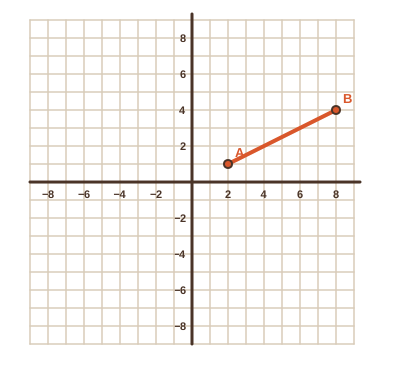
| Tool | How | From (2, 1) to (8, 4) |
|---|---|---|
| slope | change in y over change in x | 3 ÷ 6 = 0.5 |
| midpoint | average the x's, average the y's | (5, 2.5) |
| distance | square root of (change in x)² + (change in y)² | square root of 45 = about 6.71 |
The distance formula is the Pythagorean theorem in disguise. The change in x and the change in y are the legs.
The midpoint is the average of the endpoints. It divides the segment in the ratio 1:1.
A solved problem to study
Comet wants the point two thirds of the way from P (2, 1) to Q (8, 4). That divides PQ in the ratio 2:1. Here is her work.
Change in x from P to Q: 6. Two thirds of that is 4. Add it to P's x: 6.
Change in y: 3. Two thirds of that is 2. Add it to P's y: 3. The mark is (6, 3).
Why does this work? Moving along a segment moves x and y in step, so going two thirds of the way goes two thirds in each.
A ratio of a:b means the point is a parts out of a + b from the first endpoint. The midpoint is 1:1, one part of two.
- Read the question.
- Tap your answer.
The flats run from (2, 1) to (8, 4). Where does the center flat sit, at the midpoint?How long is the front of the flats, from (2, 1) to (8, 4), in meters?What is the slope of the taped line from (2, 1) to (8, 4)?- Read the question.
- Tap your answer.
Which point divides the segment from (2, 1) to (8, 4) in the ratio 2:1 from the first point?Which point is one third of the way from (2, 1) to (8, 4), the ratio 1:2?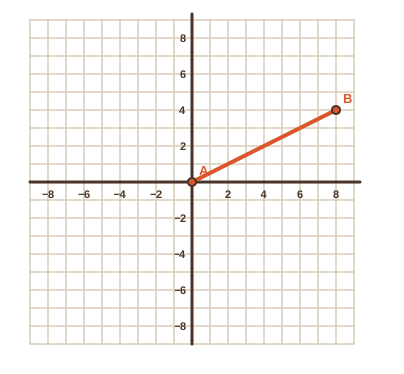 A cable runs from (0, 0) to (8, 4). Which point divides it 3:1 from (0, 0)?
| Statement | True or false? |
|---|---|
| The midpoint divides a segment in the ratio 1:1. | ? |
| The distance formula uses the Pythagorean theorem. | ? |
| A point dividing a segment 2:1 is two thirds of the way from the second endpoint. | ? |
| Slope is the change in x divided by the change in y. | ? |
| 6 × 6 + 3 × 3 = 45 | ? |
Measure the three pieces with a ruler. Are the two parts of the 2:1 split really in the ratio 2 to 1?
Good start, designer. Tomorrow slopes decide which taped edges are parallel and which meet at right angles.