Friday
Friday: Perimeter and Area from Coordinates
Comet stands at the corner of the stage apron. "The apron is a triangle: (0, 0), (8, 0), (8, 6). We need its edging."
"Perimeter," Wren says. "Three distances, added. What do you notice about two of the sides?"
"One is along the x-axis, 8 meters. One is straight up, 6 meters. The third needs the formula."
Comet works it. "10. A 3-4-5 triangle, doubled." She adds the three. "24 meters of edging."
"And paint for the top," Wren says. "Area: half the base times the height. Both are right there in the coordinates."
Nova projects the triangle with its base and height glowing. "Would you like a hint? The platform's area works the same way, tilted."
"Our designer, perimeter and area for both," Comet says. "Then we review, because next week the turntable gets an equation."
Perimeter from coordinates
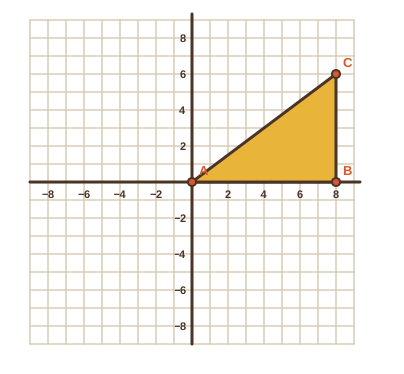
Perimeter is the sum of the side lengths. Find each side with the distance formula, then add.
Apron: 8 + 6 + 10 = 24 meters.
Platform (Wednesday's rectangle): two sides of 6.32 and two of 3.16, about 18.97 meters in all.
Area from coordinates
For a triangle with a horizontal base, read the base and the height straight from the coordinates. Area = half of base × height.
Apron: half of 8 × 6 = 24 square meters.
For a tilted rectangle, multiply two neighboring sides: 6.32 × 3.16 = about 20. Or box it in a grid rectangle and subtract the four corner triangles.
The box method gives exactly 20 square meters for the platform, with no rounding at all.
| Figure | Perimeter (m) | Area (square m) |
|---|---|---|
| apron triangle | 24 | 24 |
| platform rectangle | 18.97 | 20 |
Grids in a day
- A map with grid squares: the distance formula gives the straight-line distance between two places on it.
- A sports field chalked on a grid: slopes keep the lines parallel and the corners square.
- A tiled floor: every tile corner is a coordinate, and a diagonal tile's length comes from the formula.
- A photo on a screen: the midpoint of the frame is the average of its corner coordinates.
The week in five lines
- Slope = change in y ÷ change in x. Equal slopes: parallel. Slopes with product -1: perpendicular.
- Distance = square root of (change in x)² + (change in y)². Midpoint = average of the endpoints.
- A point dividing a segment a:b is a ÷ (a + b) of the way from the first endpoint.
- A coordinate proof uses slopes for parallel and perpendicular, and distances for equal lengths.
- Perimeter: add the distances. Area: base × height from the coordinates, or box and subtract.
- Read the question.
- Tap your answer.
What is the perimeter of the apron triangle (0, 0), (8, 0), (8, 6), in meters?What is the area of the apron triangle (0, 0), (8, 0), (8, 6), in square meters?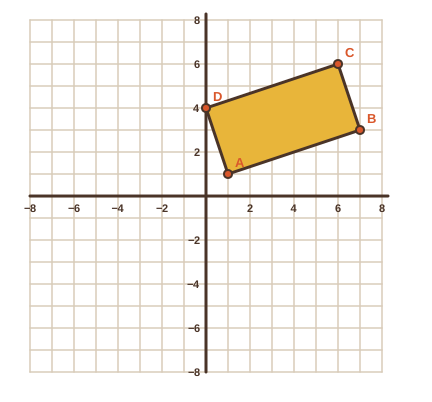 What is the area of the platform rectangle (1, 1), (7, 3), (6, 6), (0, 4), in square meters?
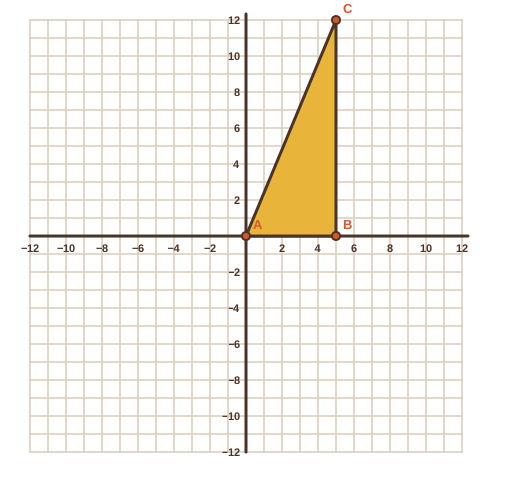 A corner piece has vertices (0, 0), (5, 0) and (5, 12). What is its perimeter?
- Read the question.
- Tap your answer.
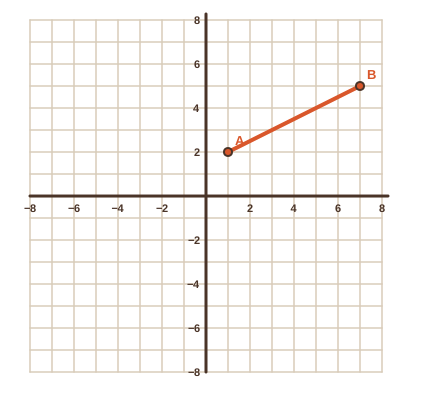 What is the midpoint of flat 1, from (1, 2) to (7, 5)?
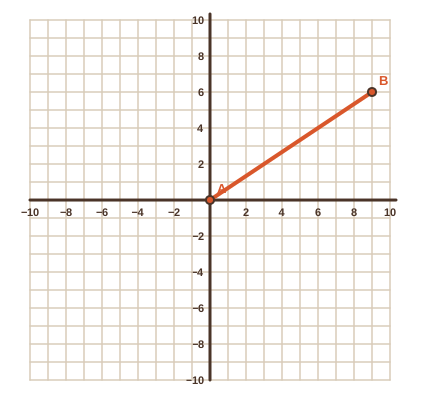 Which point divides the segment from (0, 0) to (9, 6) in the ratio 1:2 from (0, 0)?
| Week review | True or false? |
|---|---|
| The midpoint of (2, 1) and (8, 4) is (5, 2.5). | ? |
| Lines with slopes 2 and -2 are perpendicular. | ? |
| The distance formula comes from the Pythagorean theorem. | ? |
| A parallelogram with one right angle is a rectangle. | ? |
| The area of a tilted rectangle cannot be found from its coordinates. | ? |
| 8 + 6 + 10 = 24 | ? |
Find the box's area, subtract the four corner triangles, and compare with 20.
Great review, designer. Tomorrow is Shop Day: your family tapes a grid and proves a rectangle on the floor.