Tuesday
Tuesday: Three Parts Are Enough
Wren lays two braces on the bench. "I measured three parts of each and they match. Are the braces congruent?"
"Which three?" Comet asks. "Three sides, I believe. Three angles, I do not."
"Two sides and the angle between them," Wren says. "What do you notice if I line up that angle?"
Comet slides one brace so the matching corners meet, then turns it so one side lies along the other.
"The angle fixes the direction of the second side. The length fixes where it ends. The third corner is forced."
Nova projects the third sides. They lie exactly on each other. "Would you like a hint? That is SAS."
"Side, angle, side. One sequence, no guessing," Wren says. "Our designer, find the motion for each case."
The three criteria
| Criterion | Matching parts, in order around the triangle | Why it forces congruence |
|---|---|---|
| SSS | three sides | three set lengths can close in only one shape |
| SAS | two sides and the angle between them | the angle sets the direction, the lengths set the endpoints |
| ASA | two angles and the side between them | the side sets two corners, the angles set the two rays that meet at the third |
Each criterion names a sequence of rigid motions that must land one triangle on the other.
AAS also works, because the third angle is forced once two are known. Then it is ASA in disguise.
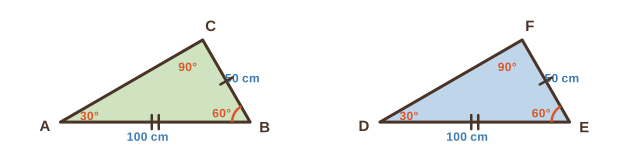
Why SAS follows from rigid motions
- Slide triangle 1 so its marked corner lands on the marked corner of triangle 2.
- Turn triangle 1 about that corner until the first marked side lies along the matching side of triangle 2.
- If the third corner is on the wrong side, reflect triangle 1 over that shared side.
- The equal angle makes the second sides point the same way. The equal lengths make them end at the same point.
- All three corners now coincide, so the triangles are congruent.
Notice what SAS used: a translation, a rotation and maybe a reflection. Nothing else was needed.
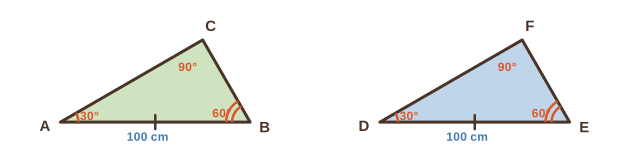
ASA runs the same way. After the side lines up, the two equal angles aim two rays that can meet at only one point.
Two methods for one check
To show two braces are congruent, name the whole sequence of motions, or match three parts with SSS, SAS or ASA.
The sequence is the definition. The criterion is the shortcut. The shortcut works only because the sequence always exists.
- Read the question.
- Tap your answer.
- Read the question.
- Tap your answer.
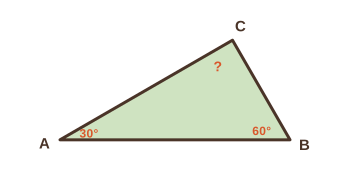 A corner brace has angles of 30° and 60°. What is its third angle?
- ?Slide triangle 1 so the marked corner lands on the matching corner
- ?Turn triangle 1 so the first marked side lies along the matching side
- ?Reflect over the shared side if the third corner is on the wrong side
- ?The equal angle and equal length force the second side to coincide
- ?All three corners coincide, so the triangles are congruent
Slide, turn and flip one onto the other. Write the sequence you used.
Excellent reasoning. Tomorrow is Shop Lab: cardboard strips and paper fasteners test every criterion.