Monday
Monday: Two Braces, One Motion
Comet holds up two triangular braces, one in each hand. "Same brace? They look the same. How do we know?"
"Last week's test," Wren says. "If a sequence of rigid motions carries one onto the other, they are congruent."
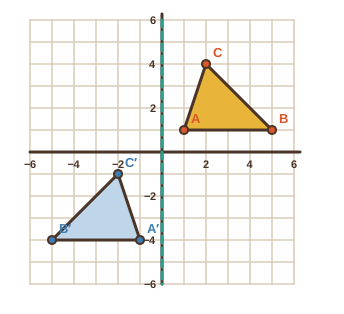
Comet lays one brace on the chalk grid, flips it over the y-axis, then slides it 5 down. It covers the other exactly.
"Every corner landed," she says. "Every side, every angle."
Nova projects the two outlines, now one. "Would you like a hint? Rigid motions keep lengths. So what must be equal?"
"All three sides and all three angles," Wren says. "Six matching parts, from one sequence."
"Our designer," Comet says, "predict where every corner lands before we move the next brace."

Congruent means a motion carries one onto the other
Two figures are congruent when a sequence of rigid motions carries one exactly onto the other.
The parts that land on each other are corresponding parts. Rigid motions keep every distance and angle, so corresponding parts are equal.
The other way works too. If two triangles have three equal sides and three equal angles, a sequence of motions carries one onto the other.
A solved problem to study
Wren's brace has corners (1, 1), (5, 1), (2, 4). The twin has corners (-1, -4), (-5, -4), (-2, -1). Here is his work.
Reflect over the y-axis: (1, 1), (5, 1), (2, 4) go to (-1, 1), (-5, 1), (-2, 4). Then slide 5 down: they land on (-1, -4), (-5, -4), (-2, -1).
Every corner of the brace lands on a corner of the twin. So the braces are congruent, and side AB (4 units) equals side A′B′ (4 units).
Why this is enough: the sequence is made of rigid motions, and rigid motions change no length and no angle.
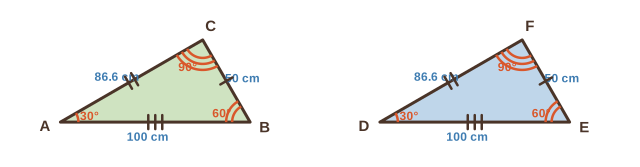
The crew's corner braces measure 50, 86.6, 100 centimeters, with angles 30°, 60°, 90°. Matching tick marks show which parts correspond.
- Read the question.
- Tap your answer.
- Read the question.
- Tap your answer.
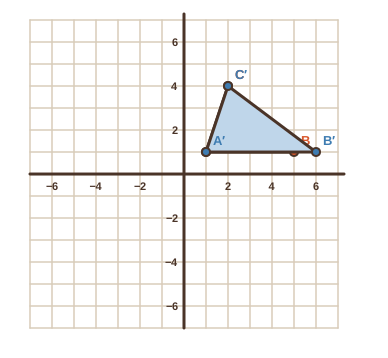 Triangle 1 has corners (1, 1), (5, 1), (2, 4). Triangle 2 has corners (1, 1), (6, 1), (2, 4). Are they congruent?
| Statement | True or false? |
|---|---|
| Congruent figures are carried onto each other by a sequence of rigid motions. | ? |
| A stretch can be one of the motions in a congruence sequence. | ? |
| Corresponding sides of congruent triangles are equal. | ? |
| Two triangles with all six parts equal might still not be congruent. | ? |
Flip the tracing over the y-axis and slide it 5 down. Does it land on (-1, -4), (-5, -4), (-2, -1)?
Strong start, designer. Tomorrow you learn why three parts, in the right order, are enough.