Wednesday
Wednesday: Shop Lab, the Cardboard Strips
Comet drops three cardboard strips on the bench: 6, 8 and 10 centimeters, with a hole punched at each end. "Lab day."
"Join the ends with paper fasteners," Wren says. "Then try to make two different triangles. What do you notice?"
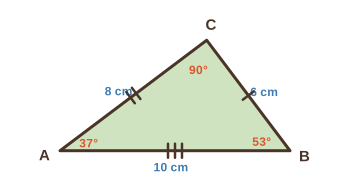
Comet fastens the strips and wiggles the triangle. It will not change shape. "One triangle. Three sides, no choice."
"That is SSS," Wren says. "Now two strips and an angle." He sets the 6 and 8 at a right angle and measures the gap.
"Ten," Comet says. "Always ten. SAS forces the third side."
Nova projects a swinging strip. "Would you like a hint? Fix an angle at one end and swing the strip opposite it."
"Two places it can land," Comet says. "Two triangles. Our designer, run the lab and record what forced each shape."
What you need
- Cardboard strips 6, 8 and 10 centimeters long, with a hole punched near each end.
- Paper fasteners, a ruler, a protractor, scissors for cardboard and your Shop Book.
- A sheet of paper to trace each triangle you build.
Keep fastener points away from fingers and faces. A grown-up holds any ladder, and nothing heavy is lifted alone.
Run the lab
- SSS: fasten the 6, 8 and 10 strips into a triangle. Try to change its shape. Measure the three angles.
- SAS: fasten the 6 and 8 strips at one end. Set a 90° angle between them. Measure the gap between the free ends.
- Change the angle to 60°. Measure the gap again. Write down that the gap changed.
- SSA: fasten the 10 and 6 strips at one end. Set a 30° angle at the free end of the 10. Swing the 6 to touch a long ruler from that corner.
- Find both places the 6 can touch the ruler. Trace both triangles.
- AAA: trace the SSS triangle, then draw a bigger triangle with the same three angles. Compare the sides.
The crew's lab table
| Test | Given parts | Result | How many triangles? |
|---|---|---|---|
| SSS | sides 6, 8, 10 | angles 37°, 53°, 90° | 1 |
| SAS | sides 6, 8 with a 90° angle between | third side 100 | 1 |
| SAS, other angle | sides 6, 8 with a 60° angle between | third side 7.2 | 1 |
| SSA | angle 30°, side 6 opposite it, side 10 beside it | third side 12 or 5.3 | 2 |
| AAA | angles 40°, 60°, 80° | sides 52.2, 70.4, 80 or 78.3, 105.5, 120 | many |
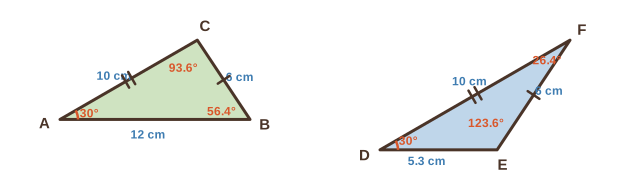
These are the crew's own measurements from the bench, in centimeters and degrees. Every number is their Wednesday data.
SSS, SAS and ASA each gave one triangle. SSA gave two: the same 30° angle, 6 and 10, but third sides of 12 and 5.3.
AAA gave a whole family: same angles, any size. Equal angles alone never fix the lengths.
- Read the question.
- Tap your answer.
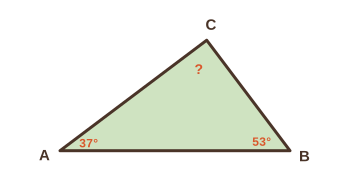 The crew measured two angles of the strip triangle: 37° and 53°. What is the third?
- Read the question.
- Tap your answer.
| What the lab shows | True or false? |
|---|---|
| Three strips of set lengths can make only one triangle shape. | ? |
| Two sides and the angle between them leave the third side free to change. | ? |
| Two sides and an angle not between them can make two different triangles. | ? |
| Three equal angles are enough to prove two triangles congruent. | ? |
Trace both triangles and measure their third sides. Compare with the crew's table.
Fine lab work, designer. Tomorrow the crew's brace data: which pairs are congruent, and by which criterion.