Tuesday
Tuesday: Defining the Three Motions
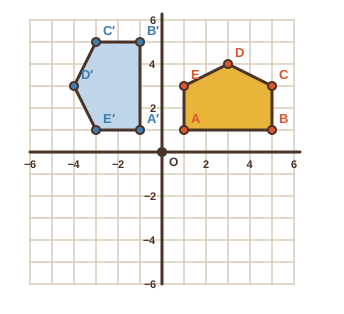
Wren pins a drawing to the corkboard: the flat, the y-axis, and its twin. "Define a reflection without saying flip."
"Each corner and its image are the same distance from the axis," Comet says, measuring. "Four squares each side for B."
"And the segment from B to B′ is perpendicular to the axis," Wren adds. "Distance and perpendicular. That is the whole definition."
Nova projects a circle around the origin through corner B. "Would you like a hint? Where does B go when the flat turns?"
"Around that circle," Comet says. "Every corner stays on its own circle and turns the same angle."
"Three motions, three definitions, all built from last week's words," Wren says. "Our designer, test the rules on every corner."
Precise definitions
| Motion | Definition | Built from |
|---|---|---|
| translation | every point moves along a segment of the same length, and all those segments are parallel | segments, parallel lines |
| reflection over line m | a point and its image are the same distance from m, on a line perpendicular to m | distance, perpendicular lines |
| rotation about center O | every point turns through the same angle about O, staying on a circle centered at O | angles, circles |
Each definition uses only words from week 1: segment, parallel, perpendicular, distance, angle and circle.
A point on the line of reflection is its own image. The center of a rotation is its own image too.
Coordinate rules and how to check them
| Motion | Rule | One corner of the flat |
|---|---|---|
| translation by (3, -5) | (x + 3, y - 5) | (5, 1) to (8, -4) |
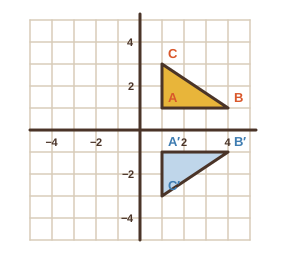
| reflection over the x-axis | (x, -y) | (5, 1) to (5, -1) |
| reflection over the y-axis | (-x, y) | (5, 1) to (-5, 1) |
| reflection over y = x | (y, x) | (5, 1) to (1, 5) |
| rotation of 90° about the origin | (-y, x) | (5, 1) to (-1, 5) |
| rotation of 180° about the origin | (-x, -y) | (5, 1) to (-5, -1) |
- Name the motion and write its rule.
- Put one corner's x and y into the rule. Plot the image corner and label it with a prime.
- Repeat for every corner and join them in the same order.
- Check with the definition: measure a distance to the line, or a distance to the center, before and after.
Two ways to check a reflection: the rule (-x, y), or the definition, equal distances on a perpendicular. Both must agree.
For B (5, 1), the rule gives (-5, 1). The definition says B and B′ are each 5 from the axis. They agree.
- Read the question.
- Tap your answer.
- Read the question.
- Tap your answer.
| Statement | True or false? |
|---|---|
| In a reflection, a point and its image are the same distance from the line of reflection. | ? |
| In a translation, the segments from each point to its image are all parallel and equal. | ? |
| In a rotation, every point moves the same distance. | ? |
| A point on the line of reflection does not move. | ? |
Turn a tracing of the brace 90° counterclockwise. Read each new corner and check it against (-y, x).
Rules and reasons. Tomorrow is Shop Lab: you move a paper flat on the grid and measure what stays the same.