Monday
Monday: A Flat and Its Twin
Comet slides a painted flat along the chalk grid. Its twin, painted as a mirror image, waits on the other side.
"Slide it three squares right and five down," Wren says, reading the plan. "What do you notice about the corners?"
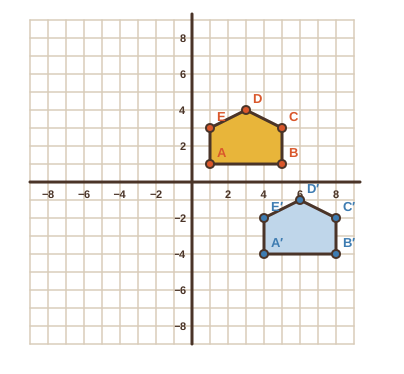
"Every corner moved the same way," Comet says. "Three right, five down. The flat did not turn or flip."
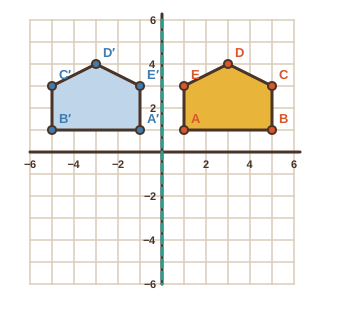
Nova projects the twin's outline over the grid, reversed. "Would you like a hint? The twin is this flat flipped over the y-axis."
"Same panel, mirror image," Wren says. "A point goes in, a point comes out. That is a function."
"A function on points," Comet says. "Our designer, write where every corner lands."

A transformation is a function
A transformation takes every point of the plane as an input and gives one point as an output, the image.
Write the image of A as A′, read "A prime". A whole figure's image is the figure made of all its image points.
Three transformations keep every distance and every angle: translations, reflections and rotations. We call them rigid motions.
| Motion | Shop word | Rule on the grid | What it keeps |
|---|---|---|---|
| translation | slide | (x + a, y + b) | every distance and angle |
| reflection over the y-axis | flip | (-x, y) | every distance and angle |
| rotation of 90° about the origin | turn | (-y, x) | every distance and angle |
| horizontal stretch | stretch | (2x, y) | angles and distances change |
A solved problem to study
Wren slides the flat with corners (1, 1), (5, 1), (5, 3), (3, 4), (1, 3) by 3 right and 5 down. Here is his work.
Rule: (x + 3, y - 5). A (1, 1) becomes A′ (4, -4). B (5, 1) becomes B′ (8, -4).
Check a length: AB is 4 units. A′B′ is 4 units. The slide kept it.
Why it works: every point moves the same distance in the same direction. Nothing bends and nothing stretches.
- Read the question.
- Tap your answer.
- Read the question.
- Tap your answer.
| Statement | True or false? |
|---|---|
| A transformation gives one image point for every input point. | ? |
| A translation moves some corners farther than others. | ? |
| A reflection keeps every side the same length. | ? |
| A horizontal stretch is a rigid motion. | ? |
Draw its image after the slide (x + 3, y - 5), then its reflection over the y-axis. Label every image corner with a prime.
Strong start, designer. Tomorrow each motion gets a precise definition, and you learn why the rules work.