Wednesday
Wednesday: Shop Lab, String, Chalk and a Circle
Comet tapes a big sheet of cardboard to the workbench. "Lab day. We build the turntable plan at small size."
Wren ties a pencil to a string and pins the other end with his thumb. "Radius 10 centimeters. Hold it steady."
Comet sweeps a full circle. "Now what can we make inside it?"
"Keep the string at the radius," Wren says. "Step it around the edge. What do you notice?"
Comet steps: one, two, three, four, five, six. The sixth mark lands on the first. "Six exactly!"
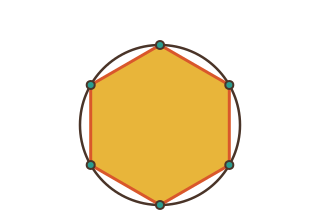
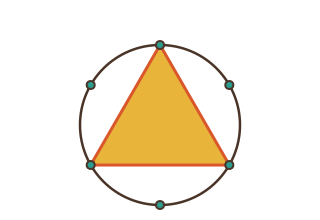
Nova projects lines joining the marks. "Would you like a hint? Join every mark, then join every other mark."
"A hexagon, and inside it a triangle," Comet says. "Our designer, run the lab and measure what we measured."
What you need
- A sheet of paper or cardboard, tape, a pencil, a sharpened pencil tied to 15 centimeters of string.
- A straightedge or ruler, a protractor for checking, and your Shop Book.
- Scissors for cardboard only, if you want to cut your hexagon out at the end.
Keep string short and never around a neck or wrist. Keep pencil points away from faces.
A grown-up holds any ladder, and nothing heavy is lifted alone.
Run the lab
- Draw a segment AB 24 centimeters long. Bisect it with two equal arcs from A and B. Measure from M to each end.
- Draw a 70° angle with the protractor. Bisect it with arcs only. Then measure each half.
- Pin the string at a center O. Sweep a circle with radius 10 centimeters.
- Keep the string at 10 centimeters. Starting at one point on the circle, step marks around the edge. Count them.
- Join neighboring marks for a hexagon. Join every other mark for a triangle. Measure every side.
- Record each measurement in a table like the crew's. Then compare.
The crew's lab table
These are the crew's own measurements from their cardboard sheet, in centimeters and degrees. Every number is their Wednesday data.
| Check | Measured | Expected | Match? |
|---|---|---|---|
| AB, then M to A | 24, then 12 | 12 | yes |
| M to B | 12 | 12 | yes |
| 70° angle, each half | 35 and 35 | 35 | yes |
| marks around the circle | 6 | 6 | yes |
| each hexagon side (radius 10) | 10 | 10 | yes |
| hexagon perimeter | 60 | 60 | yes |
| each triangle side | 17.32 | 17.32 | yes |
Each hexagon side equals the radius, 10 centimeters, because every step of the string was one radius long.
The triangle side joins marks two steps apart. The crew measured 17.32 centimeters, longer than a radius but shorter than two.
- Read the question.
- Tap your answer.
| What the lab shows | True or false? |
|---|---|
| Each side of the inscribed hexagon equals the radius of the circle. | ? |
| The equilateral triangle joins every other mark on the circle. | ? |
| Bisecting a 70° angle gives two 40° angles. | ? |
| The perpendicular bisector of AB passes through the midpoint M. | ? |
Join the four marks. You have a square inscribed in the same circle. Measure its sides.
Fine lab work, designer. Tomorrow the crew measures the real turntable and you check their numbers.