Thursday
Thursday: The Turntable Data
Wren unrolls the tape across the turntable platform. "Radius 1.2 meters, center to edge. Comet, hold the string."
Comet pins the string at the center mark. Wren steps the chalk around the rim. Six marks appear.
"Now the chords," Wren says. "Neighbor to neighbor, then every other mark. What do you notice?"
"Neighbor to neighbor is 1.2 meters, same as the radius," Comet says. "Every other mark is longer."
Nova projects a hexagon over the six marks, then a triangle over three of them. "Would you like a hint? Count the gaps."
"Six gaps around the center. One full turn shared six ways," Wren says.
"Spokes for the hexagon, spokes for the triangle," Comet says. "Our designer, read our table and check every number."
The crew's turntable table
Every number here is the crew's own made-up Scene Shop measurement in meters and degrees. Nothing is a real-world fact.
| Measurement | Value |
|---|---|
| radius (center to rim) | 1.2 m |
| chalk marks around the rim | 6 |
| chord, neighbor to neighbor (hexagon side) | 1.2 m |
| chord, every other mark (triangle side) | 2.08 m |
| hexagon perimeter | 7.2 m |
| angle between neighboring spokes | 60° |
| angle between triangle spokes | 120° |
| each corner angle of the hexagon | 120° |
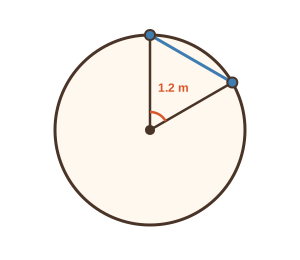
The spokes to two neighboring marks make a 60° angle. The two spokes and the chord make a triangle with two equal sides.
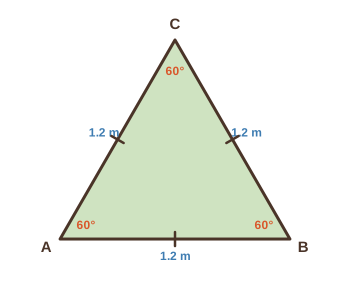
Its other two angles share the rest of 180° equally, so all three are 60°. That is why the chord equals the radius.
For the triangle, the marks are two steps apart. The chord is 2.08 meters, measured on the platform.
- Read the question.
- Tap your answer.
- Read the question.
- Tap your answer.
| Statement | True or false? |
|---|---|
| Each hexagon side on the turntable equals the radius. | ? |
| The triangle side is shorter than the hexagon side. | ? |
| The six spoke angles add to 360°. | ? |
| The square in the circle would use four marks spaced 90° apart. | ? |
Measure the triangle side. Divide it by the radius. Compare with the crew's turntable ratio.
Sharp reading, designer. Tomorrow you find constructions in everyday life and review the week.