Tuesday
Tuesday: Seven Constructions
Wren pins a page to the corkboard: seven small drawings, each made of arcs and straight lines. "Our construction kit."
"Copy a segment, copy an angle, bisect both, a perpendicular, a parallel, and shapes in a circle," Comet reads. "What can we make?"
"The back wall line first," Wren says. "Then a perpendicular through the stage mark, so the first flat stands square."
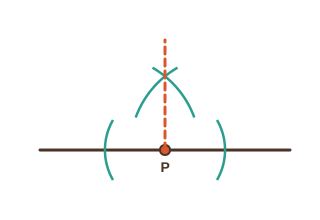
Comet swings two arcs from the mark along the wall line. Then two bigger arcs from those crossings. They meet above.
Nova projects a right-angle mark where the new line meets the wall. "Would you like a hint? Check it with the carpenter's square."
"Square," Comet says, grinning. "The compass never lies."
"It never guesses," Wren says. "Our designer, every step has a reason. Find them."
The construction kit
A construction uses only two tools: a compass (our string and chalk) to draw arcs, and a straightedge to draw lines.
The compass copies a distance. The straightedge joins two points. No measuring, no protractor, no guessing.
| Construction | Key move | Why it works |
|---|---|---|
| copy a segment | set the compass to the segment, mark that distance on a new line | the compass keeps one distance |
| copy an angle | one arc across both rays, then copy the arc and its width | equal arcs and equal chords give an equal angle |
| bisect a segment | equal arcs from both ends cross above and below | each crossing is equally far from both ends |
| bisect an angle | one arc across both rays, then equal arcs from the two crossings | the new crossing is equally far from both rays |
| perpendicular at a point | equal arcs either side of the point, then arcs from those crossings | it is the perpendicular bisector of the two side points |
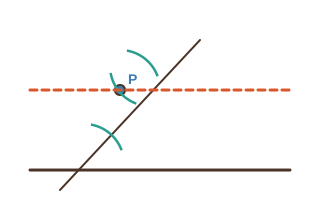
| parallel through a point | draw a slanted line through the point, then copy its angle at the point | equal corresponding angles mean parallel lines |
| hexagon in a circle | keep the compass at the radius and step six times around | each step is one side equal to the radius |
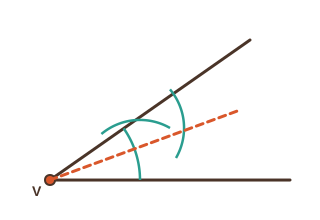
Bisect an angle, step by step
- Set the compass at the vertex V and swing one arc that crosses both rays. Call the crossings S and T.
- Keep the same radius. Swing an arc from S and an arc from T so they cross inside the angle at X.
- Draw the ray from V through X with the straightedge. That ray is the bisector.
- Check: the angle on each side of the bisector is half the original.
Why it works, and two methods for one job
Why the angle bisector works: S and T are the same distance from V. X is the same distance from S and from T.
So the two halves match side for side, and matching triangles have matching angles at V.
A parallel line through P can be built two ways. One: copy an angle so the corresponding angles match.
Two: build a perpendicular to the line, then a perpendicular to that perpendicular through P.
Both give the same line. The angle copy uses fewer arcs. The double perpendicular is easier to check with a square.
- Read the question.
- Tap your answer.
- Read the question.
- Tap your answer.
Comet needs a flat to stand at a right angle to the wall line through one mark. Which construction does she use?Wren wants a second chalk line that never meets the wall line and passes through a stage mark. Which construction?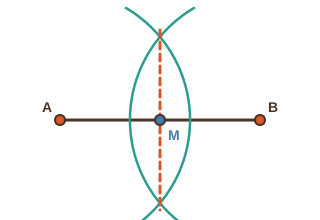 The crew wants the exact middle of a chalk segment without a tape measure. Which construction?
- ?Swing one arc from the vertex that crosses both rays at S and T
- ?Swing equal arcs from S and from T so they cross inside the angle at X
- ?Draw the ray from the vertex through X
- ?Check that the two new angles are equal
Check both halves with a protractor. Write how close they are.
Excellent work with the kit. Tomorrow is Shop Lab: string, chalk and a circle with six marks.