Monday
Monday: Three Words We Never Define
Comet unrolls a ball of string across the Scene Shop floor. "First job: a chalk grid, so every flat lands in the same spot."
"A grid needs straight lines and square corners," Wren says. "What do you notice about our tools?"
"A straightedge, a tape measure, string and chalk. No ruler is long enough for the whole floor."
Nova hovers low and projects a faint grid onto the concrete. "Would you like a hint? Tie the chalk to the string."
Comet pins one end of the string and swings the chalk. A perfect arc appears. "A compass as big as the room."
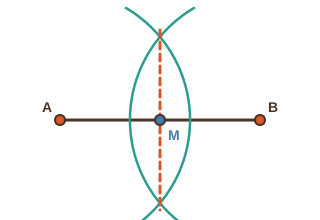
"Two arcs from two points cross at a spot the same distance from both," Wren says.
"So the crossings find the middle," Comet says. "Our designer, help us define what we draw before we draw it."
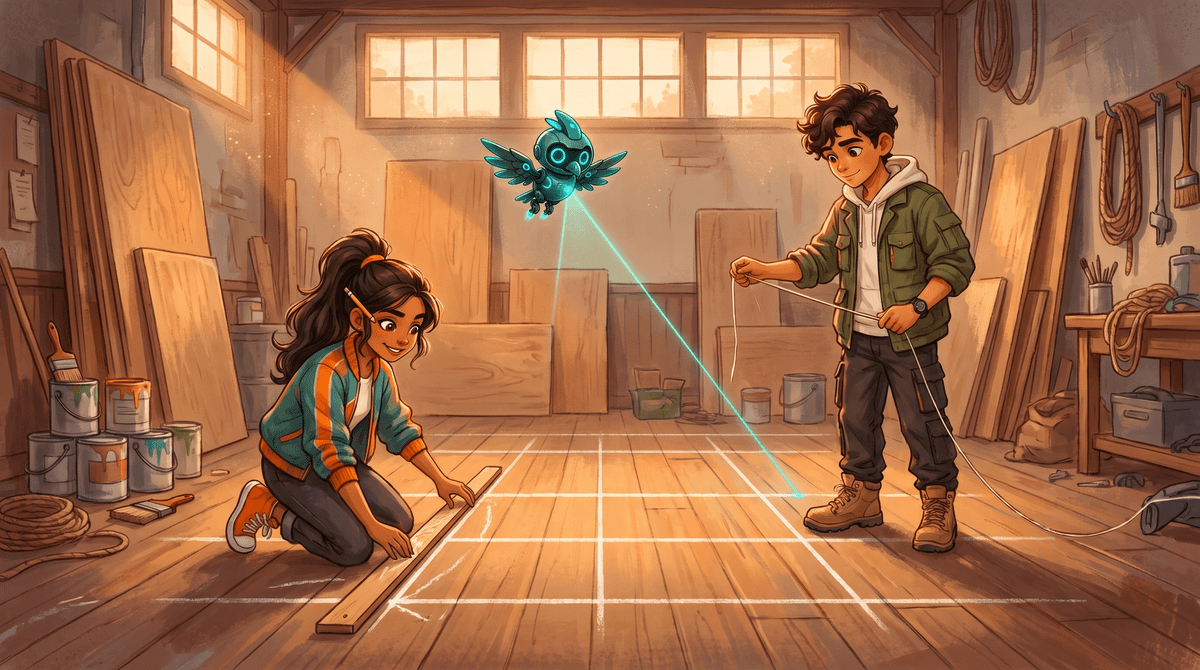
Three ideas we never define
Geometry builds everything from three ideas it never defines: a point, a line, and distance.
A point is a location with no size. A line is straight, has no thickness, and goes on forever both ways.
Distance comes in two kinds: along a line, measured with the tape, and around a circular arc, swept by the string.
| Word | Precise definition | In the Scene Shop |
|---|---|---|
| line segment | the part of a line between two points, with both endpoints | a chalk line from one tape mark to another |
| angle | two rays with a shared endpoint, the vertex | two chalk lines leaving one corner mark |
| circle | all points at one fixed distance (the radius) from one center | the turntable outline swept by the string |
| perpendicular lines | two lines that meet at a right angle (90°) | the grid lines at a square corner |
| parallel lines | two lines in one plane that never meet | two grid lines that stay the same distance apart |
A solved problem to study
Notice what each definition uses: only points, lines, distance and arcs. A good definition never uses the word it defines.
"Perpendicular" does not say "like the corner of a page." It says exactly what angle the lines make.
Wren wants the midpoint of the chalk segment from A (2, 1) to B (8, 1) without measuring. Here is his work.
He swings an arc from A and an arc from B with the same string length. The arcs cross above and below the segment.
Each crossing is the same distance from A as from B, because both arcs used the same radius.
The chalk line through the crossings cuts AB at M (5, 1). It also meets AB at a right angle, so it is the perpendicular bisector.
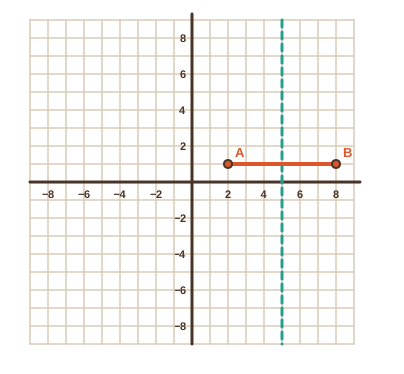
Check it with distances: Q (5, 4) sits on that line. Its distance to A is 4.24 and to B is 4.24.
R (6, 4) is off the line. Its distances are 5 to A and 3.61 to B. Not equal, so R is not on the bisector.
- Read the question.
- Tap your answer.
- Read the question.
- Tap your answer.
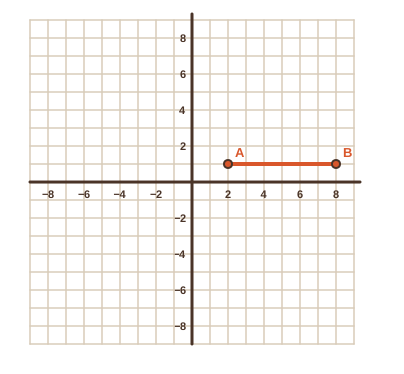 The chalk segment runs from A (2, 1) to B (8, 1). Where is its midpoint M?
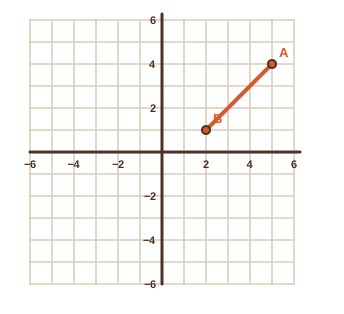 Q (5, 4) is on the perpendicular bisector of AB. How far is Q from A (2, 1)?
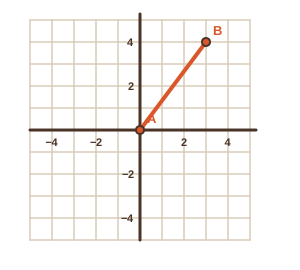 The turntable center is O (0, 0). How far is the chalk mark (3, 4) from O?
| Statement | True or false? |
|---|---|
| A point has a location but no size. | ? |
| A line segment goes on forever in both directions. | ? |
| The radius of a circle is the distance from the center to any point on it. | ? |
| The point (5, 0) is on the chalk circle with center (0, 0) and radius 5. | ? |
| The point (4, 4) is on the chalk circle with center (0, 0) and radius 5. | ? |
| Q (5, 4) is the same distance from A as from B. | ? |
Tie a pencil to a short string. Pin the free end at A with a finger and sweep an arc. Repeat from B with the same length.
Join the two crossings. Measure from the crossing line to A and to B. Are they equal?
A grown-up holds any ladder, and cutting is done with scissors on cardboard or paper only.
Strong start, designer. Tomorrow you learn seven constructions, each one built from arcs and straight lines.