Tuesday
Tuesday: Linear or Not?
Rocket lays beans in a square on the bench. One bean, then a 2 by 2 square, then 3 by 3.
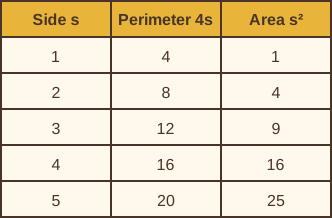
"Side 1, area 1. Side 2, area 4. Side 3, area 9," he counts. "The rule is area = side squared."
Raven plots (1, 1), (2, 4) and (3, 9). "What do you notice about the points?"
"They do not line up," Rocket says. "The jumps grow: 3, then 5, then 7."
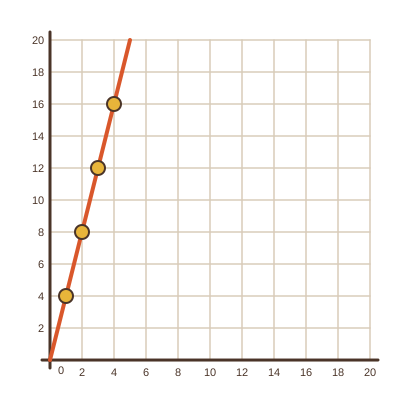
"Now plot the perimeter," Raven says. "Four times the side." Rocket plots (1, 4), (2, 8), (3, 12). "A straight line."
Nova hovers over the beans, her light on the 3 by 3 square. "y = mx + b is a line," she says. "s² is not."
Rocket nods. "Linear and not linear. Same beans, two very different graphs."
What makes a function linear
A function is linear when its rule can be written y = mx + b. Its graph is a straight line.
The test in a table: equal steps in x give equal steps in y. The rate of change never changes.
The perimeter of a square, p = 4s, is linear: each extra 1 of side adds 4. Its graph is a straight line through (0, 0).
A function that bends
The area of a square, A = s², is a function: each side gives exactly one area. But it is not linear.
From side 1 to 2 the area jumps 3. From 2 to 3 it jumps 5. From 3 to 4 it jumps 7. The steps keep growing.
Its points (1, 1), (2, 4) and (3, 9) do not lie on one straight line. The graph curves upward.
- Look at the rule. If the letter is only multiplied by a number and added to a number, it is linear.
- Look at the table. Check that equal steps in x give equal steps in y.
- Look at the graph. A straight line is linear. A curve is not.
- Read the question.
- Tap your answer.
- Read the question.
- Tap your answer.
- Read the question.
- Tap your answer.
| Statement | True or false? |
|---|---|
| Every linear function can be written y = mx + b. | ? |
| A = s² is a linear function. | ? |
| In a linear table, equal steps in x give equal steps in y. | ? |
| The graph of the area of a square is a straight line. | ? |
| p = 4s is linear with a rate of change of 4. | ? |
Then count each perimeter, the counters around the edge, and write those jumps. Which stays the same?
Straight or bent, you can tell. Tomorrow is Puzzle Lab: the dripping jug and the timer.