Wednesday
Wednesday: Puzzle Lab, The Dripping Jug
Rocket sets a jug with a pinhole in its side on an upturned box. A clear cup waits below it, on a tray.
"The cup already has 3 centimeters of water," Raven says. "Start the timer."
Drip, drip, drip. At 2 minutes Raven marks the cup. "Seven centimeters." At 5 minutes: "Thirteen."
"What do you notice about the rise?" she asks.
"From 2 to 5 minutes is 3 minutes," Rocket says. "From 7 to 13 is 6 centimeters. Two centimeters a minute."
Nova hovers above the tray, her light on the water line. "And at zero minutes?" she asks.
"Three," Rocket says. "The water that was already there. So height = 2 × minutes + 3." Nova hums. "Now predict 8 minutes."
Your mission
Make a dripping jug and time the water rising in a clear cup. Find the rate of change and the initial value from your marks.
Then write the rule and use it to predict a later minute. Check your prediction with the timer.
- A plastic jug or bottle with a small pinhole near the bottom (a grown-up makes the hole).
- A clear cup or jar, a tray or bowl to catch spills, and a towel.
- A ruler, a marker that writes on plastic or masking tape, and a kitchen timer or clock.
- Your Puzzle Notebook and a pencil.
Plastic jugs and cups only. No glass on the floor or the bench edge.
A grown-up makes the pinhole. Water is for measuring, not for drinking during the lab.
- Pour about 3 cm of water into the clear cup first. Measure it and write it down: this is your initial value.
- Fill the jug, hold a finger over the pinhole, and set it above the cup. Start the timer as you let go.
- Mark the water level on the cup at 2 minutes and at 5 minutes. Measure each mark from the bottom.
- Rate of change: subtract the heights, then divide by the 3 minutes between the marks.
- Write the rule: height = rate × minutes + initial value. Predict the height at 8 minutes.
- Let it run to 8 minutes and measure. How close was your prediction?
The crew's jug
These are the crew's own marks from the Puzzle Post tray, in centimeters. They are made-up Puzzle Post numbers.
| Minutes | Height (cm) | Ordered pair |
|---|---|---|
| 0 | 3 | (0, 3) |
| 2 | 7 | (2, 7) |
| 5 | 13 | (5, 13) |
| 8 | 19 | (8, 19) |
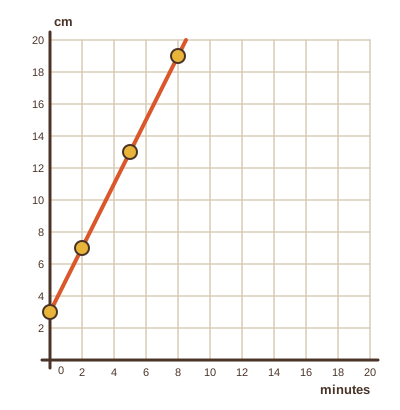
From (2, 7) to (5, 13): run 3, rise 6, so the rate of change is 2 cm a minute.
Step back to 0 minutes: 7 - 2 × 2 = 3. The initial value is 3 cm, the water poured in first.
The rule is h = 2m + 3. At 8 minutes it predicts 19 cm, and the crew measured 19.
- Read the question.
- Tap your answer.
- Read the question.
- Tap your answer.
A rule from two marks and a timer. Tomorrow the puzzle card box gives rates and starts in three forms.