Tuesday
Tuesday: Rise Over Run
Raven draws a line through (1, 2) and (3, 6) on graph paper. "Find the slope without the origin."
Rocket draws a step from the first point: across 2, then up 4. "Rise 4, run 2. Four over two is 2."
"Now use (2, 4) and (5, 10)," Raven says. Rocket draws the step. "Run 3, rise 6. Still 2!"
"What do you notice about the two triangles?" she asks.
"Same shape, different size," Rocket says. "The big one is a stretched copy of the small one."
Nova hovers over the paper, her light along the line. "Similar triangles," she says. "Same ratio of rise to run, anywhere."
Rocket grins. "So one slope fits the whole line." Nova hums. "That is why one equation does too."
Slope between any two points
Pick any two points on a line. The run is the change across, from the first x to the second.
The rise is the change up, from the first y to the second. Slope = rise ÷ run.
From (1, 2) to (3, 6): run 3 - 1 = 2, rise 6 - 2 = 4. Slope = 4 ÷ 2 = 2.
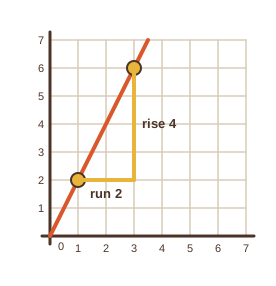
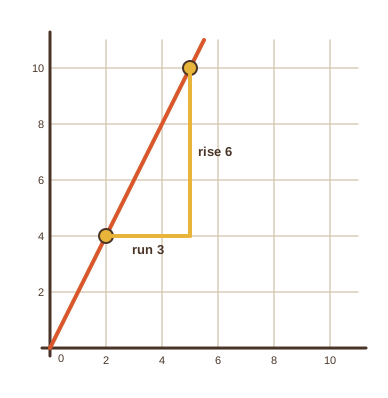
The two triangles are similar: the same shape, one a stretched copy of the other. So rise ÷ run matches.
That is why the slope is the same between any two points on a line. One number describes the whole line.
From slope to equation
A line through (0, 0) with slope m has the equation y = mx. Every point fits: y is m times x.
A line that crosses the y-axis at b has the equation y = mx + b. The b is the y-intercept, the start.
Start at b when x = 0, then rise m for every 1 across. For y = 2x + 3: start at 3, climb 2 each step.
- Pick two points on the line and write them as (x, y).
- Run: subtract the first x from the second x.
- Rise: subtract the first y from the second y.
- Slope m = rise ÷ run.
- Find b, the y when x = 0. Then write y = mx + b.
- Read the question.
- Tap your answer.
- Read the question.
- Tap your answer.
- Read the question.
- Tap your answer.
| Statement | True or false? |
|---|---|
| Slope is rise divided by run. | ? |
| The slope changes depending on which two points you pick. | ? |
| In y = mx + b, the b is where the line crosses the y-axis. | ? |
| The line y = 2x passes through (0, 0). | ? |
Rise over run, from any two points. Tomorrow is Puzzle Lab: the ramp test with a board and tape measures.