Monday
Monday: Steepness Has a Number
Rocket props a board on two books at the Puzzle Post. "A ramp! Watch the ball go." It rolls off slowly.
He adds a third book. The ball shoots across the floor. "Steeper is faster," he says.
"Steeper has a number," says Raven, spreading two graphs on the bench. "Our driveway walks from last week."
"What do you notice about the lines?" she asks. Rocket's line rises 2 meters for every second. Raven's rises 3.
Nova hovers above the graphs, her light tracing the steeper one. "The rise for one step across," she says. "Name it."
"The unit rate," Rocket says. "Two for me, three for Raven. So Raven's line is steeper, and she walks faster."
Nova hums. "That number is the slope. This week you measure it on a ramp."

The unit rate is the slope
A walker at a steady speed makes a straight line through (0, 0): zero seconds, zero meters.
The unit rate is the meters for 1 second. On the graph, it is how far the line rises for each step of 1 across.
That rise for a run of 1 is the slope of the line, written m. Rocket: d = 2t, slope 2. Raven: d = 3t, slope 3.
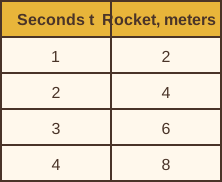
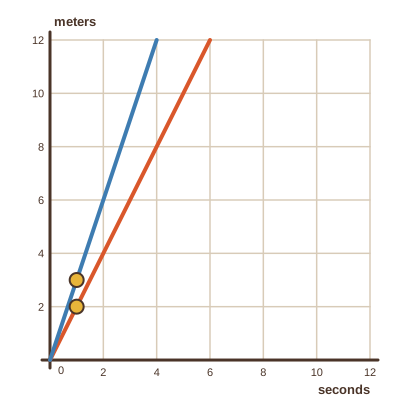
Comparing two walkers
Rocket's walk came as a graph. Raven's came as an equation, d = 3t. You can still compare them.
Read Rocket's slope from the graph: from (0, 0) to (1, 2) the line rises 2. Read Raven's from her equation: 3.
The steeper line has the bigger slope, and the bigger slope is the faster walker. Raven wins.
- Read the question.
- Tap your answer.
- Read the question.
- Tap your answer.
| Statement | True or false? |
|---|---|
| On a line through (0, 0), the slope is the unit rate. | ? |
| A steeper line has a smaller slope. | ? |
| The line d = 3t rises 3 for every 1 across. | ? |
| You cannot compare a graph with an equation. | ? |
Say which ramp is steeper and which one rolls the ball farther. Keep the ball away from stairs.
Steepness has a number now. Tomorrow you measure it between any two points with rise over run.