Thursday
Thursday: Margins and Two Trays
"Nova sampled 100 cells at random across the whole Glass House," Wren says. "60 had sprouted. 60%."
"Of the sample," Comet says. "What about everything? Is the true rate exactly sixty?"
"Almost surely not. Another sample would give another number. The question is how far off we might be."
Nova projects a rule. "Would you like a hint? The crew's simulation rule: margin = 2√(p(1 - p)/n)."
"Two times the square root of 0.6 times 0.4 over 100," Comet says, working it. "About 9.8%."
"So the Glass House rate is probably between 50.2% and 69.8%," Wren says. "What do you notice if we sampled 400 instead?"
"A margin of 4.9%. Four times the cells, half the margin. Then the two misting trays. Did daily misting really help?"
A margin of error from simulation
A sample result is close to the whole group's value, but not exact. The margin of error says how close is typical.
The crew found it by simulation. Draw many random samples of the same size from a model, record each sample's percent, and watch the spread.
The spread settled into a pattern the crew wrote as a rule: margin = 2√(p(1 - p)/n). Here p is the sample proportion and n the sample size.
For the sprout survey, p = 0.6 and n = 100: margin ≈ 9.8%. Report: 60% ± 9.8%, or about 50.2% to 69.8%.
- Take many random samples of size n from the model, the same size as the real sample.
- Record each sample's proportion.
- See how far the proportions spread around the model's value.
- Call twice that typical spread the margin of error.
- Report the sample proportion plus or minus the margin.
- ?Report the sample proportion plus or minus the margin
- ?See how far the proportions spread
- ?Take many random samples of size n from the model
- ?Record each sample's proportion
- ?Call twice the typical spread the margin of error
Comparing two trays
The crew assigned misting by coin flip: five seedlings misted daily, five weekly. Daily: 15, 16, 18, 19, 17 cm. Weekly: 13, 14, 16, 15, 12 cm.
The daily mean is 17, the weekly mean 14. The difference is 3 cm. Is that more than chance would give?
To find out, the crew shuffled all ten heights into two random groups of five, again and again. They recorded the difference each time.
If misting did nothing, the real split is just one more shuffle. So the shuffles show what chance alone produces.
| Shuffle | 1 | 2 | 3 | 4 | 5 | 6 | 7 | 8 | 9 | 10 | 11 | 12 | 13 | 14 | 15 | 16 | 17 | 18 | 19 | 20 |
|---|---|---|---|---|---|---|---|---|---|---|---|---|---|---|---|---|---|---|---|---|
| Difference (cm) | -2.2 | -1.8 | -1.4 | -1 | -1 | -0.6 | -0.6 | -0.2 | -0.2 | 0.2 | 0.2 | 0.6 | 0.6 | 1 | 1 | 1.4 | 1.8 | 2.2 | -1.4 | 0.6 |
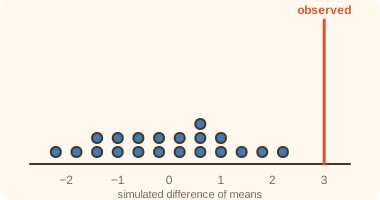
Of 20 shuffles, 0 reached 3 cm. Only 2 were as far as 2 cm from zero either way.
A difference of 3 cm is beyond anything chance produced here. The crew calls it significant: daily misting most likely helped these seedlings grow.
Because the misting was assigned by coin flip, that sentence about cause is fair. For an observational study it would not be.
- Read the question.
- Tap your answer.
- Read the question.
- Tap your answer.
| Statement | True or false? |
|---|---|
| A bigger random sample gives a smaller margin of error. | ? |
| 4 × 100 = 400 | ? |
| Shuffling the ten heights shows what chance alone would produce. | ? |
| The crew may claim cause because the misting was assigned by coin flip. | ? |
| Two groups with different means always prove the treatment worked. | ? |
Careful inference. Tomorrow you read a draft of the Open House report and decide which claims it has earned.