Friday
Friday: Reading the Report With Care
"Nova drafted the Open House report," Wren says, projecting it on the chalkboard wall. "Let us check every claim."
"Claim one. The 10 sampled seedlings average 16 centimeters," Comet reads. "We measured that. Fair."
"Claim two. Every seedling on the bench is between 12 and 20 centimeters." She frowns. "What do you notice?"
"The model says about 95% are. Not every one," Wren says. "Change 'every' to 'about 95 percent'."
"Claim three. Daily misting made the misted seedlings taller. We assigned the misting by coin, and the shuffles agreed. Fair."
"Claim four. Seedlings by the glass grow taller because of the glass."
Nova dims that line herself. "Would you like a hint? Nobody assigned the glass." "Linked, maybe," Comet says. "Caused, not shown."
Four questions for any report
- Who was measured, and how many? A sample of ten supports a weaker sentence than a sample of a hundred.
- How were they chosen? Random choosing lets the sample stand for the group. Picking the handiest ones does not.
- Was anything assigned at random? If not, a difference between groups is a link, never a cause.
- Does the number match the sentence? A model's 95% is not "every". A margin of error belongs next to every sample percent.
Nova's draft, line by line
| Claim in the draft | What the crew did | Verdict |
|---|---|---|
| The sampled seedlings average 16 cm. | measured 10 random cells | fair: it is the sample's own mean |
| Every seedling is between 12 and 20 cm. | fit a normal model | too strong: the model says about 95% |
| Daily misting made the misted seedlings taller. | assigned misting by coin and ran a shuffle test | fair: an experiment with a significant difference |
| Glass-side seedlings grow taller because of the glass. | noticed a difference, assigned nothing | too strong: observation shows a link, not a cause |
| 60% of the Glass House cells have sprouted. | sampled 100 cells at random | needs its margin: 60% ± 9.8% |
A good report keeps its sentences no stronger than its evidence. The crew rewrites two lines and adds one margin.
- Read the question.
- Tap your answer.
- Read the question.
- Tap your answer.
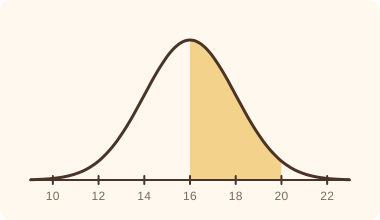 Heights follow a normal model with mean 16 and standard deviation 2. About what percent are between 16 and 20?
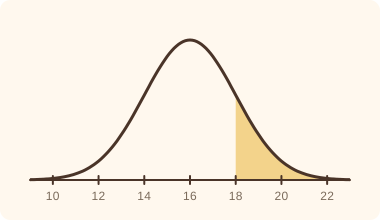 Heights follow a normal model with mean 16 and standard deviation 2. About what percent are between 18 and 22?
| Statement | True or false? |
|---|---|
| A sample percent should be reported with its margin of error. | ? |
| An observational study may claim that one thing caused another. | ? |
| About 95% within two standard deviations means a few values fall outside. | ? |
| A report's sentences should be no stronger than its evidence. | ? |
The report is honest now. Tomorrow is the Open House. Bring your charts and your four questions.