Wednesday
Wednesday: Glass House Lab, Is Nine Surprising?
"Our model from the spring trays says a seed sprouts half the time," Comet says. "This tray of 10 gave 9 sprouts."
"Lucky, or is the model wrong for this tray?" Wren asks. "What do you notice? We can ask chance itself."
"Flip 10 coins. Count heads. That is one tray under the model," Comet says. "Do it 20 times."
Coins rattle on the bench. Nova tallies. "3, 4, 4, 5, 5..." The counts pile up around five.
"20 runs," Nova says at last. "The most heads in any run was 8. Would you like a hint? Look for 9."
"Never," Wren says. "Not once in 20 tries. Under the half model, 9 of 10 is rare."
"So the model probably does not fit this tray," Comet says. "Something about it is different. A simulation told us that."
What you need
- 10 coins, or one coin flipped 10 times per run. A cup to shake them in.
- Your Glass House Log with a tally column for 0 to 10 heads.
- A flat bench or table, and a tray or box lid to keep the coins from rolling.
Shake the cup over the tray so coins do not roll to the floor. Pick up any that do, so no one slips.
A grown-up handles any hot water or ladder in the Glass House. Nothing heavy is lifted alone.
Run the lab
- Decide the model: each seed sprouts with chance 1/2, like a coin landing heads. One run is 10 flips.
- Shake and tip out the coins. Count the heads. Make a tally mark in that row of your Log.
- Repeat for 20 runs. More is better if you have time.
- Draw a dot plot of your counts: heads across, one dot per run.
- Mark the crew's tray result, 9, on the plot. Count how many runs reached 9 or more.
- Decide: is the result surprising under the model? Write your reason.
The crew's runs
The crew's 20 head counts are made up for the Glass House. Yours will differ, and that is fine; the shape should look similar.
| Run | 1 | 2 | 3 | 4 | 5 | 6 | 7 | 8 | 9 | 10 | 11 | 12 | 13 | 14 | 15 | 16 | 17 | 18 | 19 | 20 |
|---|---|---|---|---|---|---|---|---|---|---|---|---|---|---|---|---|---|---|---|---|
| Heads | 3 | 4 | 4 | 5 | 5 | 5 | 5 | 6 | 6 | 4 | 7 | 5 | 6 | 3 | 5 | 6 | 4 | 7 | 5 | 8 |
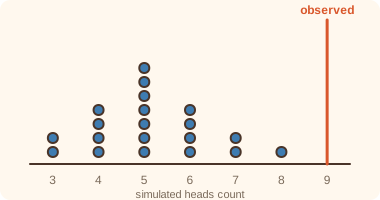
The runs average 5.2 heads, close to 5. Runs of 3 reached 7 or more; none reached 9.
A result that chance almost never produces under the model is surprising. The crew decides the half model does not fit this tray.
A result like 6 of 10 would not be surprising. Chance gave 6 or more in 7 of 20 runs.
- Read the question.
- Tap your answer.
- Read the question.
- Tap your answer.
| Statement | True or false? |
|---|---|
| A simulation shows what chance alone produces under a model. | ? |
| 3 + 17 = 20 | ? |
| A result that the simulation produces often is surprising. | ? |
| The crew's runs averaged close to 5 heads out of 10. | ? |
Good lab work. Tomorrow a simulation builds a margin of error and compares two trays of misted seedlings.