Wednesday
Wednesday: Glass House Lab, the Coin-Flip Tray
"Lab day," Comet says, setting a 24-cell egg carton on the bench with a cup of dried beans.
"Each cell gets two coin flips," Wren says. "First flip heads: put a paper flag in the cell."
"Second flip heads: drop in a bean," Comet says. "Then we count the four boxes, like a real tray."
Twenty-four cells, forty-eight flips. Comet flips, Wren places, Nova tallies. "7 flag and bean. 5 flag only."
"6 bean only. 6 empty," Nova finishes. "Would you like a hint? The flag flip never saw the bean flip."
"So they should be independent," Wren says. "P(bean given flag) should be close to P(bean). What do you notice?"
"7/12 against 13/24," Comet says. "Close, not equal. Twenty-four cells is a small tray."
What you need
- An egg carton or seed tray with 24 cells (two dozen-cartons taped together work), a coin, dried beans.
- Small paper flags: strips of paper folded over a toothpick, or just a torn scrap of paper.
- Your Glass House Log and a pencil for the tally grid.
Cut paper for the flags with scissors, on the bench. A grown-up handles any hot water or ladder in the Glass House.
Nothing heavy is lifted alone. Pick up every dropped bean so no one slips.
Run the lab
- Number the cells 1 to 24 in your Log. Make a two-row, two-column tally grid: flag or no flag, bean or no bean.
- For cell 1, flip the coin. Heads: place a flag. Tails: no flag.
- Flip again. Heads: drop in a bean. Tails: no bean.
- Repeat for every cell. Then count the four boxes and write the row and column totals.
- Find P(bean), P(flag), P(bean given flag) and P(bean and flag) from your own table.
- Compare P(bean given flag) with P(bean). Are they close? Write what you notice.
The crew's lab table
The crew's counts are made up for the Glass House. Yours will differ, and the comparison is the point.
| Bean | No bean | Total | |
|---|---|---|---|
| Flag | 7 | 5 | 12 |
| No flag | 6 | 6 | 12 |
| Total | 13 | 11 | 24 |
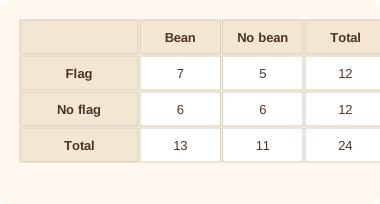
In the crew's run, P(bean) = 13/24 and P(bean given flag) = 7/12. The two flips were separate, so the true chances match.
A small tray rarely matches exactly. Tomorrow you learn the exact test for independence and what a near miss means.
- Read the question.
- Tap your answer.
One carton cell is picked at random. What is the probability it holds a bean?One carton cell is picked at random. What is the probability it has a flag?Given that a cell has a flag, what is the probability it holds a bean?What is the probability a random cell has a flag or a bean (or both)?| Statement | True or false? |
|---|---|
| The flag flip and the bean flip were made separately, so the true chances are independent. | ? |
| 7 + 5 + 6 + 6 = 24 | ? |
| A small tray will always match the true chances exactly. | ? |
| P(bean given flag) uses the flag row as its total. | ? |
Good lab work. Tomorrow you test independence exactly, on the crew's two trays, and prove the addition rule.