Thursday
Thursday: The Test for Independence
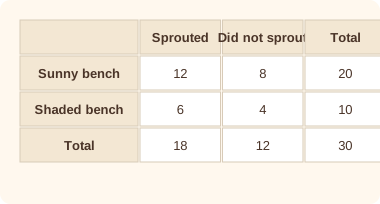
"Second tray," Wren says, chalking a new grid. "Sunny bench against shaded bench. Sprouted or not."
Comet reads the counts. "12, 8, 6, 4. What do you notice?"
"P(sprouted) is 3/5," Wren says. "P(sprouted given sunny) is 12 of 20. Also 3/5."
"And given shaded, 6 of 10. 3/5 again," Comet says. "Knowing the bench tells us nothing."
Nova projects the two trays side by side. "Would you like a hint? Try multiplying P(A) by P(B) in each tray."
"Sunny tray: 3/5 × 2/3 = 2/5. And P(sprouted and sunny) is 2/5. Equal," Wren says.
"Misting tray: 13/24 × 1/2 = 13/48, but P(sprouted and daily) is 3/8. Not equal. Misting mattered, the bench did not."
Two tests, one idea
Events A and B are independent when knowing B happened does not change the chance of A.
Test 1: compare P(A given B) with P(A). Equal means independent.
Test 2: compare P(A and B) with P(A) × P(B). Equal means independent.
The two tests always agree, because P(A given B) = P(A and B) ÷ P(B). If P(A given B) = P(A), then P(A and B) = P(A) × P(B).
The crew's two trays
| Sprouted | Did not sprout | Total | |
|---|---|---|---|
| Sunny bench | 12 | 8 | 20 |
| Shaded bench | 6 | 4 | 10 |
| Total | 18 | 12 | 30 |
| Tray | P(A) × P(B) | P(A and B) | Independent? |
|---|---|---|---|
| Bench: sprouted and sunny | 3/5 × 2/3 = 2/5 | 2/5 | yes |
| Misting: sprouted and daily | 13/24 × 1/2 = 13/48 | 3/8 | no |
In everyday words: on the bench tray, a sunny cell sprouts just as often as any cell. The bench is not linked to sprouting.
On the misting tray, a daily-misted cell sprouts more often than a cell picked at random. Misting and sprouting are linked.
A link in a table is not a cause by itself. The crew assigned the misting, so here it is fair to say misting helped.
- Read the question.
- Tap your answer.
Why the addition rule subtracts
- Count the cells in A.
- Count the cells in B.
- Adding the two counts counts every cell in both A and B twice.
- Subtract the overlap once, so every cell in A or B is counted exactly once.
- Divide by the total: P(A or B) = P(A) + P(B) - P(A and B).
- ?Divide by the total to get P(A or B) = P(A) + P(B) - P(A and B)
- ?Count the cells in B
- ?Subtract the overlap once so each cell counts once
- ?Adding the two counts counts the overlap twice
- ?Count the cells in A
| Statement | True or false? |
|---|---|
| If P(A given B) = P(A), then A and B are independent. | ? |
| 3/5 × 2/3 = 2/5 | ? |
| A link between two events in a table proves one caused the other. | ? |
| P(A or B) = P(A) + P(B) for every pair of events. | ? |
Write how far apart they are. A small carton usually misses by a little.
Careful thinking. Tomorrow you put conditional probability into everyday words and review the whole week.