Tuesday
Tuesday: Given That, Conditional Probability
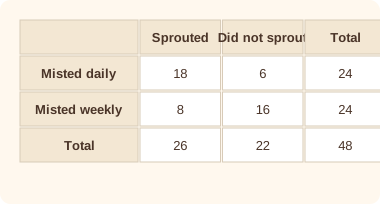
"Here is the real question," Comet says. "If I know a cell was misted daily, how likely is a sprout?"
"Then forget the weekly row," Wren says, covering it with his hand. "Only 24 cells are left. 18 sprouted."
"3/4," Comet says. "Higher than the whole tray. What do you notice if we cover the daily row instead?"
Wren slides his hand. "Weekly: 8 of 24. 1/3. Daily misting helped, in our tray."
Nova projects both fractions side by side. "Would you like a hint? There is a second way to get the same number."
"Divide probabilities instead of counts," Wren says. "P(sprouted and daily) over P(daily). 3/8 over 1/2."
"Same 3/4," Comet says. "Two ways, one answer. Given that is a powerful phrase."
Way 1: shrink the sample space
"Given that B happened" means only B's cells are possible now. The row or column for B becomes the whole world.
P(A given B) = the number of cells in both A and B, divided by the number of cells in B.
For the crew: P(sprouted given daily) = 18 ÷ 24 = 3/4.
Way 2: divide the probabilities
P(A given B) = P(A and B) ÷ P(B). Both fractions have the same total underneath, so the totals cancel.
For the crew: P(sprouted and daily) = 3/8 and P(daily) = 1/2. Dividing gives 3/4 again.
The same equation turned around gives a rule for "and": P(A and B) = P(B) × P(A given B).
Order matters
P(sprouted given daily) asks about the daily row: 3/4.
P(daily given sprouted) asks about the sprouted column: 18 of 26 = 9/13.
Same box on top, different group underneath. Read the "given" carefully every time.
| Question | Group used as the total | Count in both | Probability |
|---|---|---|---|
| P(sprouted given daily) | daily row, 24 | 18 | 3/4 |
| P(sprouted given weekly) | weekly row, 24 | 8 | 1/3 |
| P(daily given sprouted) | sprouted column, 26 | 18 | 9/13 |
| P(sprouted) | whole tray, 48 | 26 | 13/24 |
- Read the question.
- Tap your answer.
 Given that a cell is "Misted daily", what is the probability it is "Sprouted"?Given that a cell is "Misted weekly", what is the probability it is "Sprouted"?Given that a cell is "Sprouted", what is the probability it is "Misted daily"?Given that a cell is "Misted weekly", what is the probability it is "Did not sprout"?
- Read the question.
- Tap your answer.
| Statement | True or false? |
|---|---|
| P(A given B) uses B's count as the total, not the whole tray. | ? |
| 18 ÷ 24 = 3/4 | ? |
| P(sprouted given daily) and P(daily given sprouted) are always equal. | ? |
| P(A and B) = P(B) × P(A given B). | ? |
Then cover the "Did not sprout" column and read P(daily given sprouted) the same way.
Two ways that agree. Tomorrow is Lab day: a carton, a coin and a handful of beans build a tray of your own.