Monday
Monday: The Tray as a Sample Space
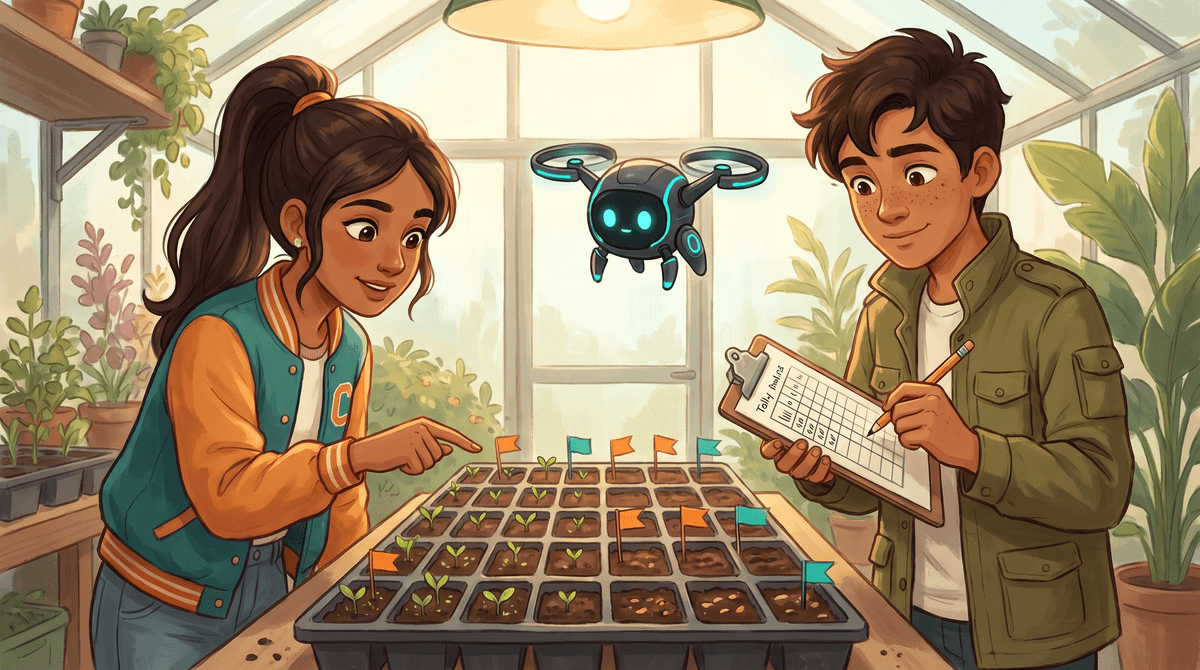
Two seed trays sit on the long bench, 48 cells in all, each with a tiny paper flag.
"Red flags were misted every day," Comet says. "Blue flags once a week. And now we count sprouts."
Wren rules a grid on the chalkboard wall: two rows, two columns. "Misted daily or weekly. Sprouted or not."
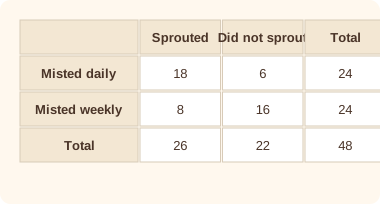
They count. 18 daily and sprouted. 6 daily and bare. 8 weekly and sprouted. 16 weekly and bare.
"What do you notice?" Wren asks.
"Every cell lands in exactly one box," Comet says. "Pick a cell at random and the table tells the chances."
Nova projects the grid with totals along the edges. "Would you like a hint? The whole table is your sample space."
"And every question we ask is a set of boxes," Wren says. "Or, and, not. Let us name them."
The crew's two-way table
Every count below is the crew's own made-up tally from Nova's log. Each cell of the tray is sorted by two questions at once.
| Sprouted | Did not sprout | Total | |
|---|---|---|---|
| Misted daily | 18 | 6 | 24 |
| Misted weekly | 8 | 16 | 24 |
| Total | 26 | 22 | 48 |
Events as sets of cells
The sample space is the set of all outcomes. Here it is the whole tray: every cell is one outcome, and picking a cell at random is the experiment.
An event is a set of outcomes. "Sprouted" is the first column. "Misted daily" is the first row.
"Sprouted and misted daily" is the one box where that row and column meet: the intersection.
"Sprouted or misted daily" is every cell in that row or that column, or both: the union.
"Not sprouted" is every cell outside the sprouted column: the complement.
A solved problem to study
Here is how Wren finds the probability that a random cell is "sprouted or misted daily".
- Count the sprouted cells: 26.
- Count the misted-daily cells: 24.
- Adding gives 50, but the 18 cells that are both were counted twice.
- Subtract the overlap once: 26 + 24 - 18 = 32 cells in the union.
- Divide by the total: 32 ÷ 48 = 2/3.
Probability is a count over a count: the cells in the event over all the cells. Write it as a fraction in lowest terms.
- Read the question.
- Tap your answer.
One tray cell is picked at random. What is the probability it is "Sprouted"?One cell is picked at random from the 48. What is the probability it was "Misted daily"?What is the probability a random cell is not "Sprouted"?What is the probability a random cell is "Misted daily" or "Sprouted" (or both)?- Read the question.
- Tap your answer.
| Statement | True or false? |
|---|---|
| Every tray cell belongs to exactly one box of the table. | ? |
| 26 + 24 - 18 = 32 | ? |
| P(not sprouted) = 1 - P(sprouted). | ? |
| The union of two events is always the sum of their two counts. | ? |
The box with both colors is the intersection. Everything with any color is the union.
A good start. Tomorrow you ask the table a sharper question: given that a cell was misted daily, what are the chances it sprouted?