Friday
Friday: Everyday Given-Thats
"My cousin says most tall seedlings were misted daily," Comet says. "So daily misting makes seedlings tall?"
"Careful," Wren says. "That is P(daily given tall). The question you want is P(tall given daily). What do you notice?"
"Different totals," Comet says. "One looks only at the tall ones. The other looks only at the daily ones."
Nova projects two shaded tables, one with a column lit, one with a row lit. "Would you like a hint? Say each one out loud."
"Of the tall seedlings, how many were misted daily. Of the daily ones, how many grew tall," Comet says slowly.
"Those can be very different numbers," Wren says. "Everyday talk mixes them up all the time."
"Then our Open House table needs clear labels," Comet says. "Every fraction says what it is given."
Saying it in everyday words
"Given that" means "among only those". P(sprouted given daily) is "among the daily-misted cells, the fraction that sprouted".
Swapping the two events swaps the group. "Among the sprouted cells, the fraction misted daily" is a different question with a different answer.
Independence in everyday words: "knowing the bench tells you nothing about sprouting". Linked: "daily cells sprout more often than cells in general".
| Everyday sentence | Probability it means |
|---|---|
| Among the daily-misted cells, three in four sprouted. | P(sprouted given daily) = 3/4 |
| Among the sprouted cells, most were misted daily. | P(daily given sprouted) = 9/13 |
| A weekly-misted cell sprouted one time in three. | P(sprouted given weekly) = 1/3 |
| Sunny or shaded, the sprout rate was the same. | P(sprouted given sunny) = P(sprouted): independent |
Review: the week in one table
- P(A) = cells in A ÷ all cells.
- P(not A) = 1 - P(A).
- P(A or B) = P(A) + P(B) - P(A and B).
- P(A given B) = cells in both ÷ cells in B = P(A and B) ÷ P(B).
- Independent: P(A given B) = P(A), or P(A and B) = P(A) × P(B).
- Read the question.
- Tap your answer.
- Read the question.
- Tap your answer.
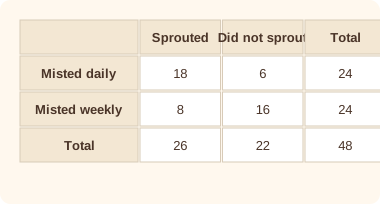 What is the probability a random cell was not misted daily?What is the probability a random cell was misted weekly or did not sprout (or both)?
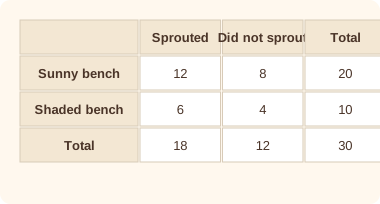 On the bench tray, given that a cell is on the shaded bench, what is the probability it sprouted?One cell is picked at random from the bench tray's 30. What is the probability it sprouted?
| Statement | True or false? |
|---|---|
| "Among the sprouted cells" means the sprouted column is the total. | ? |
| P(A given B) and P(B given A) always have the same top number. | ? |
| 8 ÷ 24 = 1/3 | ? |
| Most tall seedlings being misted daily proves daily misting makes seedlings tall. | ? |
Write one everyday sentence of your own and translate it into a probability.
A clear-headed week. Tomorrow is Garden Day: a family two-way table from whatever is in a drawer.