Wednesday
Wednesday: Glass House Lab, the Lid and the Dot
"Lab day," Comet says, taping a red dot to the rim of a jar lid. "We make our own wave."
She stands the lid on its edge on the bench and sets a protractor behind it, zero at the dot.
"Turn it ninety degrees," Wren says, ruler ready. "I measure how high the dot is above the bench."
Comet turns. Wren reads. "5 centimeters." Another quarter turn. "10." Another. "5." And back to zero.
"Up, over the top, down, back," Comet says. "What do you notice?"
Nova projects the four heights against the angles. "Would you like a hint? It is a wave in degrees."
"Midline five, amplitude five, period a full turn," Wren says. "And it starts at the bottom, not the midline. That is the shift."
What you need
- A jar lid or a round cardboard disk (the crew's lid has radius 5 cm), a small sticker or marker dot.
- A protractor, a ruler, tape and your Glass House Log.
- A flat bench or table. A grown-up nearby if you check the roof vents on a ladder.
Cut cardboard with scissors only, on the bench, away from your other hand.
Nothing heavy is lifted alone. The lid stays on the bench; it never rolls off the edge.
Run the lab
- Tape the dot to the rim of the lid. Stand the lid on its edge on the bench, dot touching the bench.
- Hold the protractor behind the lid with its center at the lid's center. The dot sits at 0°.
- Turn the lid 45°. Measure the dot's height above the bench and record it next to the angle.
- Repeat every 45° until the dot is back at the bench (360°).
- Plot height against angle. Draw the midline. Read the amplitude and the period.
- Write your model: height = a sin(angle - c) + d. Check it at 180°.
The crew's lab readings
The crew's lid has radius 5 cm. Their heights at the quarter turns are made up for the Glass House; yours will differ.
| Angle turned | Height of the dot (cm) |
|---|---|
| 0° | 0 |
| 90° | 5 |
| 180° | 10 |
| 270° | 5 |
| 360° | 0 |
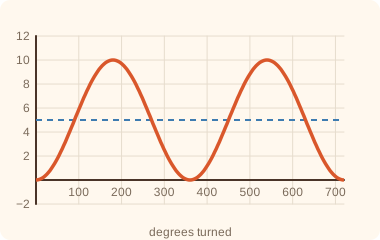
The dot starts at the bottom, height 0. A plain sine starts at its midline. So this wave is slid a quarter turn: height = 5 sin(angle - 90°) + 5.
Check at 180°: sin(90°) = 1, so the height is 5 + 5 = 10. The dot is at the top of the lid, two radii up. It matches.
The shift c = 90° is the phase shift. Change where you put the zero of the protractor and c changes with it.
- Read the question.
- Tap your answer.
- Read the question.
- Tap your answer.
| Statement | True or false? |
|---|---|
| The period of the lid wave is 360°. | ? |
| 5 + 5 = 10 | ? |
| The lid wave starts at its midline like a plain sine wave. | ? |
| The phase shift tells how far the wave is slid sideways. | ? |
Clean lab work. Tomorrow you take the temperature wave apart: shift it, stretch it and squeeze it, and read each effect.