Thursday
Thursday: Shift It, Stretch It, Squeeze It
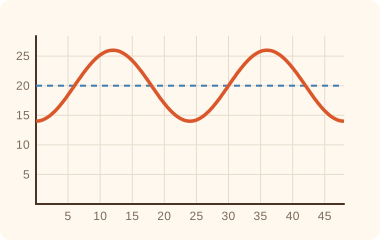
"Suppose next week runs three degrees warmer all day," Comet says. "Same vents, same timer."
"Then every reading goes up by three," Wren says. "The whole wave lifts. Midline 23, same amplitude."
"And if we open the vents wider, so the swing doubles?"
"Amplitude 12. The wave stretches up and down from the midline. What do you notice about the period?"
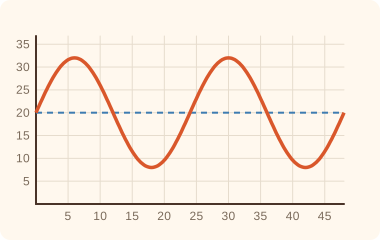
"Unchanged," Comet says. "Now the fun one. The timer runs six hours late."
Nova slides the projected wave to the right. "Would you like a hint? The peak moves, the shape does not."
"T(t - 6)," Wren says. "The peak lands at hour 12 instead of 6. Four changes, four effects. Let us prove the period rule too."
Four changes to one wave
Start with the midline-zero wave W(t) = 6 sin((π/12)t), the temperature above or below the midline. Its peak is 6 at hour 6.
| New rule | What changes | Effect on the graph |
|---|---|---|
| W(t) + k | every output rises by k | slides up k (the midline moves) |
| k × W(t) | every output is multiplied by k | stretches up and down (amplitude times k) |
| W(t - k) | the input is used k later | slides right k (the peak moves later) |
| W(k × t) | the input runs k times faster | squeezes sideways (period divided by k) |
A negative k runs each effect the other way: W(t) - 3 slides down, and W(t + 6) slides left.
Why the period is 2π ÷ b
- The sine function repeats when its input grows by 2π: sin(u + 2π) = sin u.
- In sin(bx) the input is u = bx.
- When x grows by some amount p, the input grows by b × p.
- The wave repeats as soon as b × p = 2π.
- Solve for p: p = 2π ÷ b. That is the period.
Check: b = π/12 gives p = 2π ÷ (π/12) = 24. The crew's wave repeats every 24 hours, as the log showed.
- ?So p = 2π ÷ b is the period
- ?In sin(bx) the input is bx
- ?When x grows by p, the input grows by b × p
- ?The sine function repeats when its input grows by 2π
- ?The wave repeats when b × p = 2π
- Read the question.
- Tap your answer.
- Read the question.
- Tap your answer.
| Statement | True or false? |
|---|---|
| Multiplying the output by 2 doubles the period. | ? |
| W(t - 6) slides the wave 6 units to the right. | ? |
| 2 × 12 = 24 | ? |
| Adding 3 to the output changes the midline but not the amplitude. | ? |
| 6 × 2 = 12 | ? |
Sharp reasoning. Tomorrow you read key features off the wave and use the model to fill in the hours between readings.