Wednesday
Wednesday: Glass House Lab, Tape the Circle
The chalk circle is dry and the axes are sharp. Comet holds the string at the stand, Wren holds the protractor.
"Thirty degrees," he says. Comet marks the rim. Wren lays the tape from the y-axis to the mark: "0.87."
"And from the x-axis up to it: 0.5," Comet reads. "Cos 30 and sin 30, right off the floor."
"What does the evidence say at 120°?" Wren asks. They swing the string past the y-axis and mark again.
"-0.5 across, the other way," Comet says. "And 0.87 up. Same as 60°, with x negative."
Nova projects the readings in a table beside the exact values. "Would you like a hint? Compare each pair."
"They match to two places," Wren says. "The floor agrees with the triangles."
What you need
- A string one unit long (one meter, or one big floor tile), chalk or masking tape, a protractor and a tape measure.
- A flat open floor or a driveway, and your Glass House Log with a table ready.
- A partner to hold the center while you mark the rim.
Mark a dry floor only. If the floor is wet, wait, or use masking tape on a table instead.
Nothing is heated and nothing heavy is lifted. A grown-up handles any cleaning of the chalk.
Run the lab
- Tie the string to a fixed center. Swing it around to chalk a circle of radius one unit.
- Chalk two axes through the center. The right-hand point on the circle is 0°.
- Set the protractor at the center. Mark the rim at 30°, 45°, 60°, 120°, 210° and 300°.
- For each mark, measure across from the y-axis for x and up or down from the x-axis for y.
- Write a minus sign when the mark is left of the y-axis or below the x-axis.
- Beside each reading, write the exact value from the special triangles as a decimal. Compare.
The crew's readings
The crew's tape readings are made up for the Glass House and rounded to two places. Yours will differ a little, and that is fine.
| Angle | Tape x (m) | Tape y (m) | Exact (cos θ, sin θ) |
|---|---|---|---|
| 30° | 0.87 | 0.5 | (√3/2, 1/2) |
| 45° | 0.71 | 0.71 | (√2/2, √2/2) |
| 60° | 0.5 | 0.87 | (1/2, √3/2) |
| 120° | -0.5 | 0.87 | (-1/2, √3/2) |
| 210° | -0.87 | -0.5 | (-√3/2, -1/2) |
| 300° | 0.5 | -0.87 | (1/2, -√3/2) |
The tape readings at 30° and 60° swap: (0.87, 0.5) and (0.5, 0.87). The two triangles are the same triangle turned over.
At 210° both readings are negative, and at 300° only y is. The quadrant, not the triangle, sets the signs.
Every reading in this table is a crew measurement, and √3/2 ≈ 0.87 is just arithmetic.
- Read the question.
- Tap your answer.
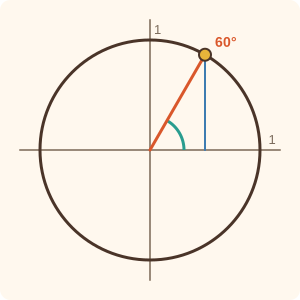 The 60° mark on the chalk circle. What is its exact x-coordinate, cos 60°?
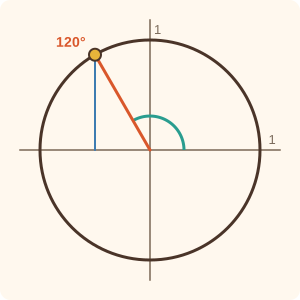 The 120° mark on the chalk circle. What is its exact y-coordinate, sin 120°?
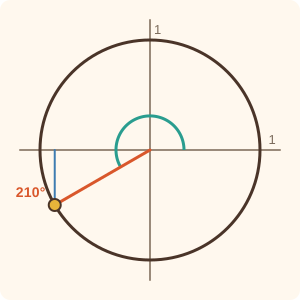 The 210° mark, below and left of the stand. What is cos 210°?
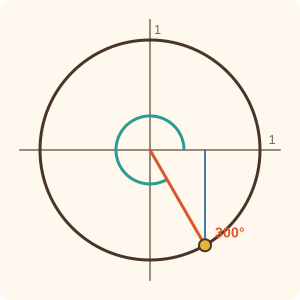 The 300° mark, below and right of the stand. What is sin 300°?
| Statement | True or false? |
|---|---|
| The tape x at 30° equals the tape y at 60°. | ? |
| At 210° the x reading is positive. | ? |
| 0.5 × 0.5 + 0.87 × 0.87 < 1.01 | ? |
| At 300° the y reading is negative. | ? |
| A larger chalk circle would give different values of sine and cosine. | ? |
Careful measuring. Tomorrow you prove why those squares always add to one.