Thursday
Thursday: Proof Day, the Squares Add to One
"Yesterday every pair of readings did the same thing," Wren says, chalk in hand. "Square them, add them, get one."
"0.87 squared plus 0.5 squared," Comet says, working it out. "Close to one. Is that luck?"
"Not luck. Today we say why." Wren draws the circle, a point P on it, and the radius from the center to P.
"Drop a line from P straight down to the x-axis," he says. "What do you notice?"
"A right triangle," Comet says. "Legs cos θ and sin θ. Hypotenuse the radius, which is one."
Nova glows along the three sides. "Would you like a hint? You proved something about right triangles in Geometry."
"Pythagoras," Comet says. "Leg squared plus leg squared equals hypotenuse squared. Which is one squared. Which is one."
The theorem
For every angle θ, sin²θ + cos²θ = 1. Read sin²θ as (sin θ)², the sine squared.
Today we prove it for an angle in quadrant 1, then say why the other quadrants follow.
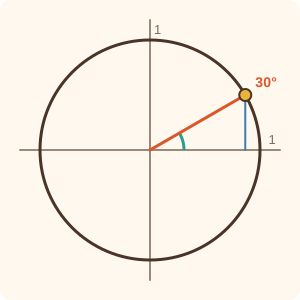
The proof, read first
- Let P be the point on the unit circle at angle θ. By definition, P = (cos θ, sin θ).
- The radius from the origin to P has length 1, because the circle has radius 1.
- Drop a perpendicular from P to the x-axis. This makes a right triangle with the radius as hypotenuse.
- The horizontal leg has length cos θ, the x-coordinate of P. The vertical leg has length sin θ, the y-coordinate.
- By the Pythagorean theorem, leg² + leg² = hypotenuse²: (cos θ)² + (sin θ)² = 1².
- So sin²θ + cos²θ = 1.
In the other quadrants, a coordinate may be negative, but its square is the same. The triangle is the same size.
On an axis there is no triangle, but the point is (1, 0), (0, 1), (-1, 0) or (0, -1). The squares still add to 1.
Every step uses a fact you already own: the definition of the unit circle (Tuesday) and Pythagoras (Geometry).
Using the identity
Suppose sin θ = 3/5 and θ ends in quadrant 2. Then cos²θ = 1 - 9/25 = 16/25, so cos θ is 4/5 or -4/5.
Quadrant 2 has negative x, so cos θ = -4/5. The identity gives the size, the quadrant gives the sign.
- ?Let P = (cos θ, sin θ) be the point on the unit circle at angle θ
- ?The radius to P has length 1
- ?Drop a perpendicular from P to the x-axis, making a right triangle
- ?So sin²θ + cos²θ = 1
- ?The legs are cos θ and sin θ, and the hypotenuse is the radius, 1
- ?Pythagoras: (cos θ)² + (sin θ)² = 1²
- Read the question.
- Tap your answer.
| Statement | True or false? |
|---|---|
| In the proof, the hypotenuse of the triangle is the radius, length 1. | ? |
| 3 × 3 + 4 × 4 = 5 × 5 | ? |
| sin²θ + cos²θ = 1 only holds in quadrant 1. | ? |
| If sin θ = 3/5 in quadrant 2, then cos θ = 4/5. | ? |
| The identity gives the size of the missing value and the quadrant gives its sign. | ? |
Clear reasoning. Tomorrow the string goes past one full turn, and the circle keeps up.