Tuesday
Tuesday: The Point on the Circle
Wren chalks two axes through the center of the circle, so the stand sits at the origin.
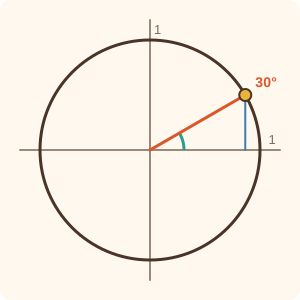
"Swing the string to 30° and mark where it meets the circle," he says. Comet marks it and measures.
"About 0.87 across and 0.5 up," she reads. "Those look like my 30-60-90 triangle."
"They are," Wren says. "The hypotenuse is the string, length 1. So the legs are cos 30° and sin 30°."
Nova lights the point. "Would you like a hint? Every point on this circle is (cos θ, sin θ)."
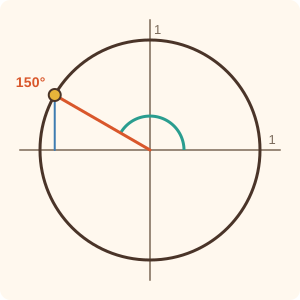
"Even past 90°?" Comet asks, swinging the string to 150°. "The x is negative now."
"Then cos 150° is negative," Wren says. "Same size as cos 30°, other sign. The circle decides."
Sine and cosine as coordinates
Start at (1, 0) and turn counterclockwise through an angle θ. The point where the arm meets the circle is (cos θ, sin θ).
For an acute angle, this is the right-triangle definition from Geometry, with hypotenuse 1.
For any other angle, it is the definition. Cosine is the x-coordinate, sine is the y-coordinate, for every θ.
The special triangles
A 45-45-90 triangle with hypotenuse 1 has legs √2/2 each. So the 45° point is (√2/2, √2/2).
A 30-60-90 triangle with hypotenuse 1 has legs 1/2 and √3/2. So 30° gives (√3/2, 1/2) and 60° gives (1/2, √3/2).
These exact values are the whole first quadrant. The other quadrants reuse them with signs.
| Angle | Radians | Point (cos θ, sin θ) | Quadrant or axis |
|---|---|---|---|
| 0° | 0 | (1, 0) | axis |
| 30° | π/6 | (√3/2, 1/2) | quadrant 1 |
| 45° | π/4 | (√2/2, √2/2) | quadrant 1 |
| 60° | π/3 | (1/2, √3/2) | quadrant 1 |
| 90° | π/2 | (0, 1) | axis |
| 150° | 5π/6 | (-√3/2, 1/2) | quadrant 2 |
| 180° | π | (-1, 0) | axis |
| 270° | 3π/2 | (0, -1) | axis |
Two ways to find cos 150°
Way one, by symmetry: the 150° point is the mirror of the 30° point across the y-axis. Same y, opposite x.
Way two, by reference angle: 180° - 150° = 30°. Take cos 30° = √3/2, then make it negative because quadrant 2 has negative x.
Both ways give cos 150° = -√3/2 and sin 150° = 1/2. The crew uses the reference angle, and checks with the picture.
Signs by quadrant
- Quadrant 1 (0° to 90°): x and y both positive, so sine and cosine are both positive.
- Quadrant 2 (90° to 180°): x negative, y positive. Cosine negative, sine positive.
- Quadrant 3 (180° to 270°): both negative.
- Quadrant 4 (270° to 360°): x positive, y negative. Cosine positive, sine negative.
- Read the question.
- Tap your answer.
 What is sin 30°?What is cos 150°?
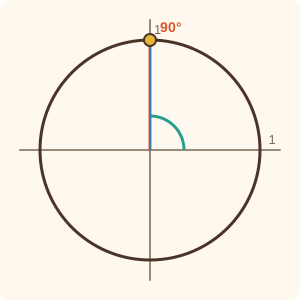 What is sin 90°?
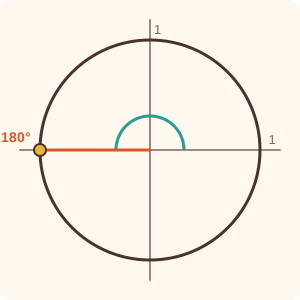 What is cos 180°?
- Read the question.
- Tap your answer.
- ?Write the answer: cos 150° = -√3/2
- ?Find the reference angle: 180° - 150° = 30°
- ?Take the first-quadrant value: cos 30° = √3/2
- ?Locate 150° on the circle: past 90°, before 180°, so quadrant 2
- ?Read the sign from the quadrant: x is negative in quadrant 2
| Statement | True or false? |
|---|---|
| On the unit circle, cosine is the x-coordinate and sine is the y-coordinate. | ? |
| In quadrant 2, cosine is positive. | ? |
| The 45° point is (√2/2, √2/2). | ? |
| sin 150° = -1/2. | ? |
| The reference angle for 150° is 30°. | ? |
Excellent. Tomorrow the tape measure meets the chalk circle in the Glass House Lab.