Monday
Monday: A String One Meter Long
The sprinkler stand sits on the brick floor, and Comet ties a string exactly one meter long to its base.
She pulls it tight and swings a chalk circle around the stand. "A circle of radius one. What can we make of it?"
"Lay the same string along the rim," Wren says. "From the mark at the right, going counterclockwise."
Comet does. The string covers a stretch of arc and stops. "That arc is one meter long. So what?"
Nova projects the angle from the center to the string's end. "Would you like a hint? Measure that angle."
"About 57 degrees," Wren reads from the protractor. "That angle is one radian. One radius of arc."
"Then a full turn is 2π radians," Comet says. "About 6.28 string lengths around. Let me check with the tape."

Radians are arc lengths
On a circle of radius 1, measure an angle by the length of arc it cuts off. That length is the angle in radians.
One radian cuts off an arc one radius long. A full turn cuts off the whole circumference, 2π radians.
Half a turn is π radians, which is 180°. So 1° is π/180 radians, and 1 radian is 180/π degrees, about 57°.
With 3.14 for π, a full turn of the crew's 1 m circle is 6.28 m of string. The crew's tape agrees.
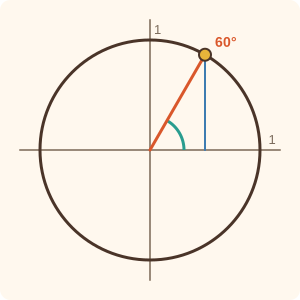
A solved problem to study
- Convert 60° to radians. A half turn, 180°, is π radians.
- So 60° is 60/180 of a half turn, which is 1/3 of π.
- Write it: 60° = π/3 radians.
- Check the arc length on the 1 m circle: π/3 ≈ 3.14 ÷ 3 ≈ 1.05 m.
- Comet lays the string along the 60° arc. It reads about 1.05 m. The conversion is right.
Going the other way, replace π with 180°. So π/4 radians is 180/4 = 45°, and 3π/2 radians is 270°.
Every length here is the crew's own tape reading on the chalk circle, not a fact about anything else.
The special angles
| Degrees | Radians | Arc on the 1 m circle (m) |
|---|---|---|
| 0° | 0 | 0 |
| 30° | π/6 | 0.52 |
| 45° | π/4 | 0.79 |
| 60° | π/3 | 1.05 |
| 90° | π/2 | 1.57 |
| 180° | π | 3.14 |
| 270° | 3π/2 | 4.71 |
| 360° | 2π | 6.28 |
- Read the question.
- Tap your answer.
| Statement | True or false? |
|---|---|
| One radian cuts off an arc one radius long. | ? |
| A full turn is π radians. | ? |
| 3.14 ÷ 2 = 1.57 | ? |
| 180° equals π radians. | ? |
| π/6 radians is 60°. | ? |
Count how many string lengths go around the whole rim. Is it a little more than six?
A strong first lap. Tomorrow every angle gets a point on the circle, and sine and cosine become coordinates.