Wednesday
Wednesday: Glass House Lab, Build the Box
Six cardboard sheets lie on the bench, all 24 by 18 centimeters. Comet holds the scissors. "Lab day. Six boxes, six cuts."
"One, two, three, four, five, six," Wren says, labeling a sheet for each cut size.
Comet cuts a square from each corner of the first sheet, folds the sides and tapes them. "Cut 1. Shallow tray."
By the fourth sheet the box is deep and narrow. "What do you notice?" Wren asks.
"Cut 3 feels biggest," Comet says. "Let us measure instead of feeling."
A grown-up pours dried beans from a pitcher and the crew levels each box flat and counts the cups.
Nova records every count. "Would you like a hint? Compare your cups to V(x) from Monday."
"Cup counts rise to cut 3 and then fall," Wren says. "The cubic was right."
What you need
- Six pieces of cardboard or card stock, all the same size, and a ruler.
- Scissors, tape, a pitcher of dried beans and a measuring cup.
- Graph paper and your Glass House Log.
A grown-up handles any ladder and lifts the heavy pitcher of beans with you.
Beans are for measuring, not for eating. Sweep up any that spill so no one slips.
Run the lab
- Measure your sheet. Write L and W and the function V(x) = (L - 2x)(W - 2x)x.
- On each sheet, draw a square of side x in every corner, x = 1 through 6.
- Cut out the squares with scissors, fold up the four sides and tape the corners.
- Fill each box level with dried beans. Pour the beans into the measuring cup and record the cups.
- Work out V(x) for each cut from the formula. Compare with the cup counts in a table.
- Circle the cut with the largest volume. Sketch V(x) from x = 0 to x = W ÷ 2.
The crew's lab table
The crew's sheet is 24 by 18. Every value is their own, worked from the formula. Your sheet will differ.
| Cut x | Base | V(x) from the formula |
|---|---|---|
| 1 | 22 by 16 | 352 |
| 2 | 20 by 14 | 560 |
| 3 | 18 by 12 | 648 |
| 4 | 16 by 10 | 640 |
| 5 | 14 by 8 | 560 |
| 6 | 12 by 6 | 432 |
| 7 | 10 by 4 | 280 |
| 8 | 8 by 2 | 128 |
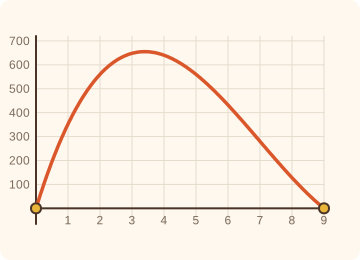
The graph starts at 0 and climbs to a peak just past x = 3. Then it falls to 0 again at x = 9.
At x = 9 the width 18 - 2x is 0, so there is no box. Cuts bigger than 9 make no sense in the build.
The function itself has another zero at x = 12, where 24 - 2x = 0. The build never gets there.
- Read the question.
- Tap your answer.
| Statement | True or false? |
|---|---|
| (24 - 2 × 4) × (18 - 2 × 4) × 4 = 640 | ? |
| (24 - 2 × 9) × (18 - 2 × 9) × 9 = 0 | ? |
| V(x) is positive for every x between 0 and 9. | ? |
| A cut of 10 centimeters makes a real box from the crew's sheet. | ? |
| The cup counts in the lab must match the formula exactly. | ? |
Careful measuring. Tomorrow you look between the zeros: turning points, multiplicity and where the graph just touches.