Tuesday
Tuesday: Zeros and Ends
Wren tapes graph paper across the Glass House chalkboard. "Rough sketches only. Two facts and a curve."
"Which two?" Comet asks.
"Where it crosses zero, and what it does far away," Wren says. "Try p(x) = (x + 2)(x - 1)(x - 3). What do you notice?"
"Each factor is zero somewhere," Comet says. "x = -2, x = 1, x = 3. Three dots on the axis."
Nova projects the expanded form, x³ - 2x² - 5x + 6. "Would you like a hint? Far away, only the x³ matters."
"Big negative x gives a big negative x³," Comet says. "So the left end falls. The right end rises."
She draws a curve down from the left, up through -2, down through 1, up through 3 and away.
"Rough, but right," Wren says. "Three zeros, two turns, and the ends point the right way."
Way one: zeros from factors
A product is zero when a factor is zero. So each factor x - a gives a zero at x = a.
For p(x) = (x + 2)(x - 1)(x - 3) the zeros are -2, 1, 3. The graph meets the x-axis at each one.
For p(x) = x³ - 4x, factor first: x(x - 2)(x + 2). Zeros -2, 0, 2.
Way two: end behavior from the leading term
Far from zero, the highest-power term is so large that the others hardly matter. Look only at the leading term.
Odd degree: the two ends point opposite ways. Even degree: both ends point the same way.
A positive leading coefficient sends the right end up. A negative one sends it down.
| Leading term | Degree | Left end | Right end |
|---|---|---|---|
| x³ | odd | down | up |
| -x³ | odd | up | down |
| x⁴ | even | up | up |
| -2x⁴ | even | down | down |
The crew's sketch table
| Polynomial | Zeros | Degree | End behavior |
|---|---|---|---|
| x³ - 4x | -2, 0, 2 | 3 | down on the left, up on the right |
| (x + 2)(x - 1)(x - 3) | -2, 1, 3 | 3 | down on the left, up on the right |
| x⁴ - 5x² + 4 | -2, -1, 1, 2 | 4 | up on the left, up on the right |
| -x³ + x² + 6x | -2, 0, 3 | 3 | up on the left, down on the right |
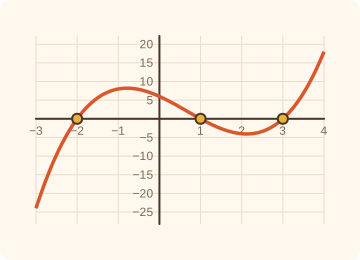
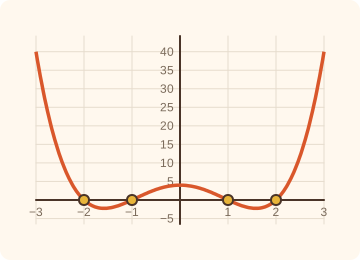
A degree-n polynomial has at most n zeros and at most n - 1 turning points. The sketch between the zeros is rough, and that is fine.
- Read the question.
- Tap your answer.
- Read the question.
- Tap your answer.
- ?Odd degree and positive coefficient: down on the left, up on the right
- ?Set each factor to zero: the zeros are -2, 1 and 3
- ?Draw a smooth curve through the zeros that matches both ends
- ?Expand or inspect to find the leading term, x³
- ?Mark the three zeros on the x-axis
| Statement | True or false? |
|---|---|
| The graph of a degree-3 polynomial can have four zeros. | ? |
| A positive leading coefficient sends the right end of the graph up. | ? |
| x⁴ - 5x² + 4 points the same way at both ends. | ? |
| (0 - 2 + 2) × (0 - 2 - 1) × (0 - 2 - 3) = 0 | ? |
| 1 - 2 - 5 + 6 = 0 | ? |
Now put a minus sign in front and sketch again. What flipped?
Good sketching. Tomorrow is Lab day: you build the box, fill it and find the cut that holds the most.