Thursday
Thursday: Touch or Cross?
Wren writes p(x) = (x - 2)²(x + 1) on the chalkboard. "Sketch it," he says.
"Zeros at 2 and -1," Comet says. "Degree 3, leading term x³. Down on the left, up on the right."
She draws a curve up through -1, then down through 2, then up. "Three crossings need three zeros. I only have two."
"What do you notice about the factor at 2?" Wren asks.
"It is squared," Comet says slowly. "(x - 2)² is never negative. The graph cannot cross there."
Nova projects the curve: up through -1, down to touch the axis at 2, then back up. "Would you like a hint? Multiplicity."
"The factor appears twice, so the zero has multiplicity 2," Wren says. "Even multiplicity touches. Odd crosses."
"Touch or cross," Comet says. "One more thing to read before I draw."
The derivation, read first
Why does an even multiplicity touch without crossing? Read the steps, then put them in order below.
- Take p(x) = (x - 2)²(x + 1) and look near x = 2. There the factor x + 1 is close to 3, so it is positive.
- The factor (x - 2)² is a square, so it is never negative. It is 0 only at x = 2.
- Just left of 2, (x - 2)² is a small positive number, so p(x) is positive.
- Just right of 2, (x - 2)² is again a small positive number, so p(x) is again positive.
- The sign of p(x) is the same on both sides of 2. The graph comes down to the axis and goes back up.
- A single factor (x - a) changes sign at a, so the graph crosses. A squared factor does not, so it touches.
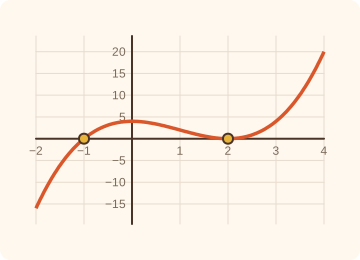
Expanded, p(x) = x³ - 3x² + 4. The expanded form hides the touch. The factored form shows it.
A zero of multiplicity 3 crosses, but flattens as it passes. Odd always crosses, even always touches.
- ?Just right of 2, p(x) is positive too
- ?Same sign on both sides, so the graph touches the axis and turns back
- ?Just left of 2, p(x) is positive
- ?Near x = 2 the other factor, x + 1, stays positive
- ?The factor (x - 2)² is a square, so it is never negative
Turning points and intervals
Between two zeros where the graph crosses, it must turn around at least once. That high or low point is a turning point.
The crew's box function rises from x = 0 to a peak just past x = 3. Then it falls to x = 9. One turning point in the build.
Say it in the build's words: as the cut grows from 0 to about 3, the box holds more. Past that, it holds less.
| Polynomial | Zero | Multiplicity | Touch or cross |
|---|---|---|---|
| (x - 2)²(x + 1) | 2 | 2 | touch |
| (x - 2)²(x + 1) | -1 | 1 | cross |
| x²(x - 3) | 0 | 2 | touch |
| (x + 1)³(x - 4) | -1 | 3 | cross and flatten |
- Read the question.
- Tap your answer.
- Read the question.
- Tap your answer.
| Statement | True or false? |
|---|---|
| A zero of even multiplicity touches the x-axis without crossing. | ? |
| (x - 2)² is negative for x just left of 2. | ? |
| A degree-3 polynomial has at most 2 turning points. | ? |
| (1 - 2) × (1 - 2) × (1 + 1) = 2 | ? |
| (3 - 2) × (3 - 2) × (3 + 1) = 4 | ? |
Check one point between the zeros of each by substitution.
Sharp reasoning. Tomorrow you read every key feature of a graph in the words of the build.